A Level 2 chimney inspection is a Level 1 check plus a video scan of the flue and a look at the chimney in attics, basements and crawl spaces. You need one when something changes: a sale, a new appliance, a new fuel, or a chimney fire or storm. You also need one when a basic look can't settle whether the chimney is safe. In the U.S., it typically costs $200 to $1,000, depending on the chimney and how hard it is to reach.
Don't wait for smoke in the living room. Hidden flue damage gives no warning.
TL;DR
- A Level 2 inspection includes everything in Level 1, plus accessible attic, basement and crawl space sections and a video scan of the flue interior.
- It is called for when the conditions of service change: new appliance, new fuel, property transfer, or an event likely to have damaged the chimney.
- National cost range: $200 to $1,000. Chimney size, number of flues and access drive the price.
- It is not a simple pass or fail. It reports the condition and serviceability of the system, and may point to a Level 3 inspection.
- Buying a home with a fireplace? Book it before closing, not after the first fire.
Table of Contents
- What a Level 2 chimney inspection is
- Level 1, Level 2 and Level 3 side by side
- When a Level 2 inspection is needed
- What the inspector actually does
- How to read the report
- What a Level 2 chimney inspection costs
- Why wet weather makes this worse in the Seattle area
- Our perspective
- Book a Level 2 inspection in the Seattle area
- After the inspection: what repairs usually follow
- Quick checklist before you call
- FAQ
- Sources
What a Level 2 chimney inspection is
The Chimney Safety Institute of America (CSIA) defines three inspection levels so that sweeps, inspectors and homeowners all mean the same thing when they say "Level 2." The standard is built on NFPA 211, the U.S. code for chimneys, fireplaces and vents.
Level 2 includes everything defined for Level 1. It then adds the accessible portions of the fireplace, chimney and connected appliances. It also requires a video scan of the chimney interior. The inspector works with common tools and ladders for access.

The word "accessible" matters. The proposed NFPA 211 text says a Level 2 inspection covers accessible areas without removing permanently attached parts of the chimney or building. No walls are opened. No bricks come out. If something can't be seen without demolition, that is a different inspection.
Level 1, Level 2 and Level 3 side by side
| Level 1 | Level 2 | Level 3 | |
|---|---|---|---|
| Scope | Readily accessible areas | Level 1 plus accessible attics, basements, crawl spaces | Level 2 plus removal of parts to reach hidden areas |
| Flue interior | Visual check from what can be reached | Video scan or similar imaging | Whatever it takes to evaluate the suspected problem |
| Typical trigger | Same appliance, same fuel, routine annual check | Change in use, sale, damage event, or Level 1 not enough | Suspected hazard that Level 1 or 2 can't evaluate |
| Destructive? | No | No | Can be |
The proposed NFPA 211 revision describes Level 1 as covering readily accessible areas. Level 2 adds accessible attics, basements and crawl spaces plus image scanning of flue interiors. Level 3 is reserved for areas suspected of malfunction or damage that Level 1 or 2 can't properly evaluate.
When a Level 2 inspection is needed
A Level 2 is not an annual routine for a chimney that hasn't changed. It is the right call in these cases.
Buying or selling a home
Property transfer is one of the circumstances listed in the proposed NFPA 211 revision. A buyer has no history on what was burned in that fireplace, how often it was swept, or whether a past fire cracked the liner. A general home inspector looks at what is visible from the firebox and the roof. A camera goes where the eye can't.
First-time buyers should ask for the chimney to be inspected during the contingency period. Findings can become repair requests or a price conversation. Waiting until after closing turns them into your bill.
Changing the appliance or the fuel
The NFPA language covers appliance additions or removals and dissimilar replacements. Examples:
- Swapping a wood fireplace for a gas insert
- Adding a wood stove to an existing flue
- Switching from oil to gas on a furnace that shares the chimney
- Relining or altering the shape or material of the flue
A flue that was safe for one appliance can be unsafe for another. Gas exhaust is cooler and wetter than wood smoke, and it can attack a masonry flue that was fine for decades.
After a fire, storm or earthquake
The proposed code also lists incidents likely to have damaged the chimney. That means a chimney fire, a lightning strike, a hard impact, a seismic event or a major windstorm. Cracked flue tiles can look perfectly normal from the roofline.

A chimney fire isn't always dramatic. Some burn quietly and still crack the liner. If you heard a roar or saw flames at the cap, schedule a Level 2 before the next fire.
When Level 1 can't answer the question
A sweep may find heavy staining, a blocked flue, smoke spilling into the room or crumbling mortar, and still not be able to say why. That is what Level 2 is for: to determine serviceability when a basic look falls short.
What the inspector actually does
Expect a few hours on site for a typical single-flue chimney. The order below is a common workflow. Individual inspectors vary.
- Interview. The inspector asks what you burn, how often, and what has changed. Tell them about past fires, leaks and smoke problems.
- Exterior check. Crown, cap, flashing, brick and mortar joints, and the lean or movement of the stack.
- Firebox and damper. Condition of the firebrick, the smoke chamber, the damper and the hearth.
- Attic, basement and crawl space. Every accessible stretch of the chimney, looking for water stains, gaps near wood framing and signs of heat damage.
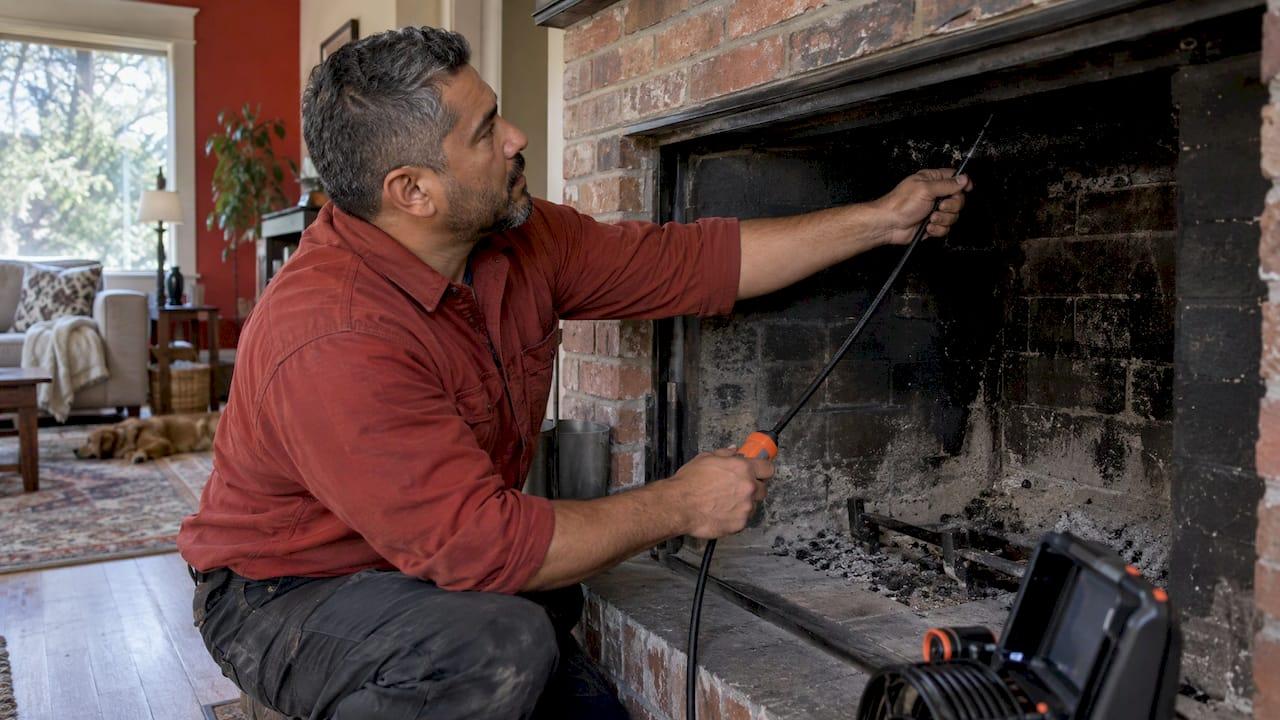
- Video scan. A camera travels the full length of the flue. It records cracked or missing tiles, gaps at joints, deposits and liner problems.
- Report. Findings, photos and recommendations.
A gas fireplace gets the same camera work on its vent, plus a look at the burner, the connections and the venting. Gas appliances that cycle on and off or smell wrong should be looked at by a technician who works on them, not just a sweep.
How to read the report
A good report is written plainly and shows what the camera saw. It usually sorts findings into three groups.
- Serviceable as is. Nothing found that blocks safe use.
- Needs repair before use. Cracked tiles, failed liner, a missing cap, damaged crown, deteriorated mortar.
- Needs further evaluation. Something suspected but not provable at this level.
That last group matters. The Level 2 is not a pass-or-fail stamp. It is used to verify that a chimney is suited to changed conditions of service or, when Level 1 isn't enough, to determine serviceability. If the report says an area can't be properly evaluated, a Level 3 is the next step, and it can involve removing parts of the chimney or the building around it.
When you read the report, ask three things:
- Which findings are safety hazards, and which are maintenance?
- Which can wait a season, and which can't?
- Where is the photo for each finding?
If a recommendation has no picture behind it, ask for one.
What a Level 2 chimney inspection costs
Across the U.S., a Level 2 chimney inspection runs $200 to $1,000. That is a wide range because the price follows the job:
- Inspection level. Level 2 costs more than Level 1 because it takes longer and uses camera gear.
- Chimney size and height. A tall, three-story stack takes more time than a short one.
- Number of flues. Each flue needs its own scan.
- Accessibility. Steep roofs, tight crawl spaces and cluttered attics add time.
- Report detail. Some reports run a few pages of photos and notes.
The low end of the range tends to fit a simple, single-flue chimney that is easy to reach. The high end fits large, multi-flue or hard-to-access systems. We don't publish a flat price for Level 2 inspections, because the honest number depends on what the inspector will find at your house. Call for a quote and ask what the quote includes.
Compare the cost to the alternative. A scan before closing is a small line item next to a relined flue or a rebuilt stack discovered after move-in.
Questions to ask before you book
- Is the camera scan included in the quoted price?
- Do you inspect attic and crawl space sections?
- Will I get a written report with photos?
- Are you CSIA certified, licensed and insured?
- If you find a problem, can you quote the repair, and is the inspection fee credited?
Why wet weather makes this worse in the Seattle area
Water is the slow enemy of a masonry chimney. Rain gets in through a cracked crown, a missing cap or failed flashing. It then soaks mortar, rusts dampers and cracks flue tiles through freeze and thaw. In a wet climate, small defects don't stay small.
That is why a Level 2 is worth more than a quick look from the ground. The weak spot is often inside. A stain in the attic, damp brick near the ceiling or a flue that shows white powder are all signs to check. If you see them, our chimney repair guide for Tacoma homeowners walks through what to look for outside.
Our perspective
We see the same pattern on a lot of calls. A homeowner lights the first fire of the season, or a buyer is a week from closing, and nobody has looked inside the flue in years.
A Level 1 is the right tool for a chimney that hasn't changed. But the moment the house is sold, the fuel changes or the weather does damage, it stops being enough. That is when we recommend a Level 2, and we recommend it without hesitation. The camera finds what a flashlight can't.
Our approach is built on transparency. We aim to document inspections with before-and-after photos, so you see what we see. We aim to quote upfront, so the decision to repair stays yours. Our crews are licensed and insured local experts, and we are available around the clock when something can't wait.
If we find a problem, we say where it is, show it, and explain the options. A cracked liner can be relined. A crumbling crown can be repaired. A leaking stack can be waterproofed. Most of it is fixable, and it is cheaper to fix early.
Pre-season is the best time to book. Schedules are open and the savings from our pre-season promotions are real.
Damon
Book a Level 2 inspection in the Seattle area
Prime Chimney serves homeowners and property managers across the Seattle metro area, including Bellevue, Bothell, Shoreline, Woodinville and Duvall. Our chimney inspection service covers Levels 1 through 3, with photo-documented findings and a clear explanation of what each one means.

Need a sweep at the same visit? See our chimney sweep service. Heavy soot or glazed buildup? Our creosote removal service handles it. If the camera finds damage, the same team handles chimney repair, relining and rebuilds, so you are not hunting for a second contractor.
After the inspection: what repairs usually follow
A Level 2 report often leads to one of these. We list them so nothing in the report is a surprise.
- Cap or crown repair. Keeps rain out of the flue and masonry. Often the first and cheapest fix.
- Flashing repair. Stops leaks where the chimney meets the roof.
- Tuckpointing and masonry repair. Replaces failing mortar and damaged brick. See our masonry repair page.
- Relining. A new liner restores a cracked or unsuited flue. Needed most often after a fuel change or a chimney fire. Our chimney relining page explains the options.
- Waterproofing. Protects brick that is taking on water.
- Rebuild. When the stack is past repair, part or all of it is taken down and rebuilt.
- New appliance. If the chimney can't safely serve the old unit, a different fireplace installation may fit better.
Don't light fires until you know the flue is serviceable. Smoke, soot and carbon monoxide don't care how nice the fireplace looks.
Quick checklist before you call
- Note the last time the chimney was swept or inspected.
- Write down what you burn: wood, gas, pellets.
- List any changes: new appliance, new fuel, new liner.
- Check the attic for stains or damp near the chimney.
- Photograph any visible cracks, leaning or white staining on the brick.
- Clear access to the fireplace, attic hatch and crawl space.
Five minutes of prep can shorten the visit and sharpen the report.
FAQ
What is the difference between a Level 1 and a Level 2 chimney inspection?
Level 1 is a check of the readily accessible parts of the chimney, for a system that hasn't changed. Level 2 includes all of that, plus accessible attic, basement and crawl space sections and a video scan of the flue. It is used when conditions change or Level 1 can't settle the question.
How much does a Level 2 chimney inspection cost?
Nationally, estimates run from $200 to $1,000. The price depends on chimney size, number of flues, access and the level of inspection. Ask for a written quote that confirms the camera scan and report are included.
Do I need a Level 2 inspection when buying a house?
It is strongly advised for a home with a fireplace. The proposed NFPA 211 revision lists property transfer among the reasons for a Level 2. A general home inspection doesn't scan the inside of the flue, so schedule the chimney inspection within your contingency period.
What do you need to pass a Level 2 chimney inspection?
There is no pass or fail grade. The inspection reports whether the chimney is serviceable for its intended use, and lists any repairs needed. If an area can't be evaluated, the report may call for a Level 3 inspection.
Sources
- Level 2 Inspection of a masonry chimney, CSIA
- Committee Input No. 9, NFPA 211 Chapter 15
- Everything to Know About Chimney Inspection Cost, Bob Vila