
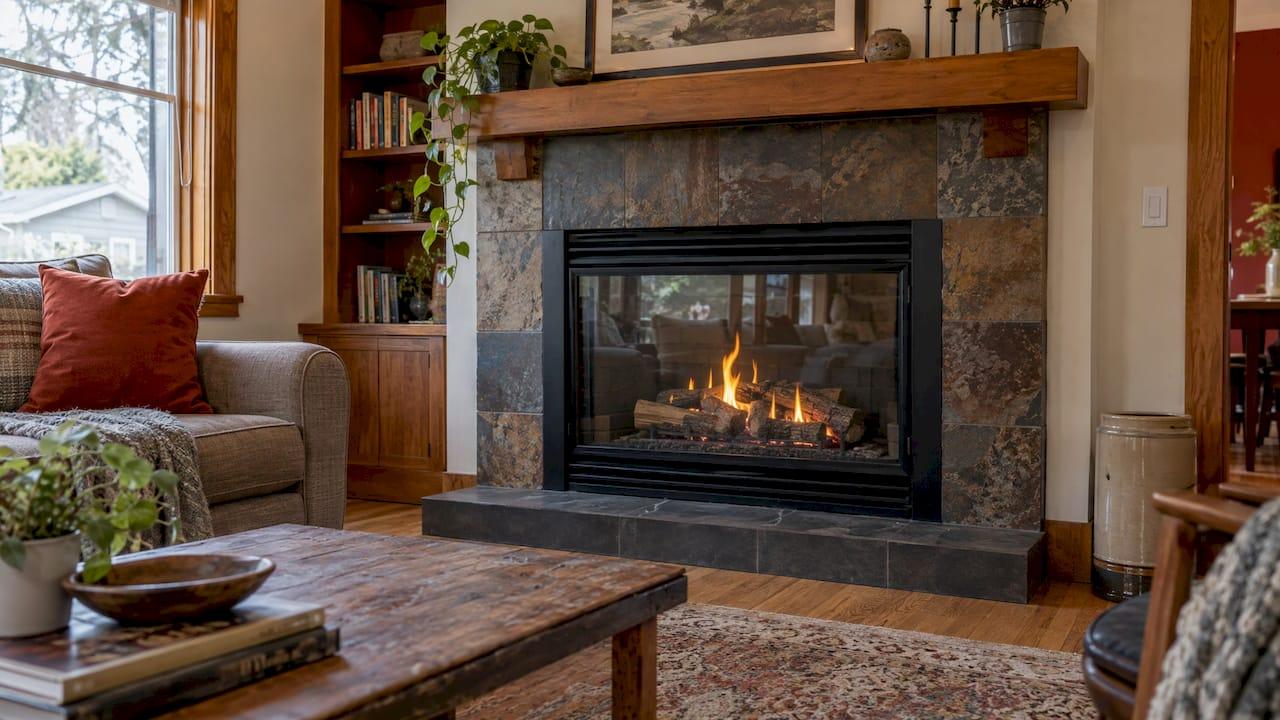
A gas fireplace that won't light, smells odd or cycles off is telling you something. Shut it off. Book a licensed technician. Tacoma's wet, cold months put these units to work, and small faults turn into safety problems when the burner, the vent or the gas connections are not right. Prime Chimney serves Tacoma and the greater Seattle area with gas fireplace diagnostics and repairs. Here is what to watch for, what the work usually costs, and how to get it done right.
TL;DR
- Smell gas? Leave the house, then call your gas utility or 911 from outside. Do not flip switches or use the fireplace.
- Pilot that won't stay lit, a weak flame, soot, a clouded glass or a CO alarm all call for a professional visit.
- Federal guidance says fuel-burning appliances, gas fireplaces included, should be inspected by a trained professional at the start of every heating season.
- Published national figures put a maintenance visit at roughly $100 to $220. Repairs depend on the failed part and the labor.
- We diagnose and repair gas fireplaces across the Tacoma area. Licensed, insured, photo-documented work.
Table of Contents
- Signs your gas fireplace needs repair
- When to stop using it and call right away
- What a professional gas fireplace visit covers
- How often should a gas fireplace be serviced?
- What gas fireplace repair costs in Tacoma
- Repair or replace?
- Between visits: what you can safely do
- Tacoma-specific concerns
- For first-time buyers and property managers
- Perspective
- Book a gas fireplace repair in Tacoma
- FAQ
- Sources
Signs your gas fireplace needs repair
Do not wait for a full failure. These are the common warnings:
- The pilot goes out or won't light. A pilot that keeps dropping out points to a part that is worn or a draft or venting problem. See our guide to gas fireplace pilot light repair for causes and costs.
- The burner flame looks wrong. Weak, lazy, noisy or lifting flames mean the gas, air or burner needs attention.
- Soot or black marks on the glass, logs or surrounding wall.
- Clouded glass that returns soon after cleaning.
- A fan that rattles, hums or stops.
- A remote or wall switch that works some days and not others.
- Unusual smells when the unit runs.
- A carbon monoxide alarm that sounds or trips more than once.
- Cracked or shifting logs, damaged gaskets or door seals.
One fault can mask another. A unit that "just needs a new part" may also have a blocked or damaged vent. A proper visit checks the whole system, not one symptom.
When to stop using it and call right away
Some signs are not "call this week." They are "stop now."
The smell of gas
Utilities add an odor to natural gas so even a small leak is noticeable. Puget Sound Energy lists steps to follow if you smell it, and they start with getting out and calling from a safe place. See its natural gas safety guidance. In short: leave, take everyone with you, call from outside, and do not use switches, lighters or phones inside. Once the utility clears the home, call a technician before you relight anything.
Carbon monoxide symptoms or alarms
The EPA says carbon monoxide cannot be seen or smelled and can kill at high levels. If an alarm sounds and anyone has symptoms, get everyone out immediately and seek medical attention. Details are on the EPA carbon monoxide page. Once the home is safe, the fireplace stays off until a professional has checked it and its venting.
Heavy soot, a cracked glass front or a damaged vent
Turn the unit off. Do not run it "just for tonight." Soot and damaged glass or venting mean combustion or exhaust is not behaving as designed.
What a professional gas fireplace visit covers
The Hearth, Patio & Barbecue Association (HPBA) says a technician should check the gas lines, clean the burner, control compartment, fan and air circulation passages, and check for condensation each year. It also says the vents must be unobstructed. That is on its gas burning maintenance page. The same page says the best person for the job is a specialty technician trained in gas fireplaces and their venting.
Manufacturer guidance is just as specific. Montigo's maintenance guide says the annual inspection must include:
- a visual check of the entire vent system and termination
- the explosion relief flappers and door gaskets
- the burner, vent run and primary air openings
- the gas valve, fittings, pilot and main burner flames
- any optional equipment, such as fans and remotes
The same guide gives minimum gas pressure figures for natural gas and propane units. Those numbers are for a technician with a manometer. They are not a home project.
Does a gas fireplace need a chimney sweep?
Not the way a wood fire does. Gas burns cleaner, so creosote is not the concern. But the vent still needs inspection. Many gas fireplaces in Tacoma homes vent through an old masonry chimney, a liner or a direct-vent pipe. A blocked flue, a failed liner, a missing cap or nesting animals can all stop exhaust from leaving the house. If your unit shares a chimney with a wood-burning setup, or you are unsure what you have, ask for a chimney inspection alongside the gas diagnostics.
How often should a gas fireplace be serviced?
Once a year, before the heating season. The EPA recommends that fuel-burning appliances, including gas fireplaces, be inspected by a trained professional at the beginning of every heating season. It also asks that flues and chimneys be connected, in good condition and not blocked. Napoleon, a fireplace maker, gives the same annual advice in its guide to gas fireplace inspection.
In Tacoma that means early fall. It is November now. If you have not had your unit checked this season, book it before the coldest weeks, when schedules fill.
What gas fireplace repair costs in Tacoma
We do not publish flat prices for gas fireplace repair, because the cost depends on what failed. Here is how the work breaks down.
Maintenance visit. National pricing data from LatestCost lists maintenance visits at $100 to $220, averaging $160, with parts from $0 to $350 and labor at $70 to $125 per hour depending on region. Treat that as a national reference, not a Tacoma quote.

Repair visit. A cost guide from EstimatorSuite puts typical gas fireplace repair at $200 to $1,000, depending on the part. Again, national figures.
What moves the price
| Factor | Why it matters |
|---|---|
| The failed part | A thermocouple or igniter is a smaller job than a gas valve or control module. |
| Unit age and brand | Older or specialty units may need parts ordered, adding time. |
| Vent type | Direct-vent, B-vent and masonry-chimney systems need different checks. |
| Access | A unit set in a tight surround or a high mantle takes longer to open up. |
| Timing | Emergency and after-hours calls differ from scheduled visits. |
| Venting repair | A damaged liner, cap or crown is masonry or metal work on top of the fireplace work. |
We give upfront pricing. After the diagnosis, you hear what is wrong, what it takes to fix, and what it costs, before work begins. Our inspections come with photos, so you can see the problem yourself.
Permits
Repair of a like-for-like part rarely changes the installation. A new unit, a new gas line or a changed vent is different. Permit fee estimates for Tacoma fireplace work range widely, $75 to $800, according to PermitMint, with gas insert installs estimated at $100 to $350. That is an aggregator estimate, and the page itself covers Vancouver, WA, so confirm with the City of Tacoma before planning a install. If you are replacing instead of repairing, our fireplace installation team can walk you through what the job involves.
Repair or replace?

Age decides a lot. Gas fireplaces are known for durability and can last about 20 to 25 years, per US Fireplace Store, and reputable brands often warrant major components for about 10 years. Inserts often run 10 to 20 years, according to Supreme Fireplace & Hearth, which lists reduced performance, damage, unusual smells and recurring malfunctions as signs it may be time to replace.
A simple rule of thumb:
- Repair when the fault is one part, the unit is in its normal service life and the venting is sound.
- Think about replacing when the same failures keep coming back, parts are hard to find or the firebox itself is damaged.
- Fix the venting first when the chimney or liner is the issue. A new unit on a bad flue is the same problem with a newer face.
Logs wear out too. KB Johnson says logs in a vented fireplace should be replaced about every 10 to 12 years, and vent-free logs every three to five.
Between visits: what you can safely do
Keep it simple. Napoleon advises looking over the exterior for damage, checking visible parts inside, vacuuming dust and debris where you can reach, and watching the flame each time you light the unit. Call a professional about anything that seems out of place. Montigo says glass, firebox and logset cleaning is fine for a comfortable owner, and the annual inspection belongs to a qualified technician.
Do not adjust gas pressure, open sealed combustion parts or move the logset from its factory layout. Keep clutter, curtains and holiday decor away from the unit. Test your CO and smoke alarms at the start of the season.
Tacoma-specific concerns
Tacoma gets long stretches of rain. Water finds the weak spot in a chimney: a cracked crown, a missing cap, loose flashing, deteriorated mortar. A gas unit that vents through that chimney can suffer from moisture, rust and blockage even if the fireplace itself is fine. Our guide to chimney repair in Tacoma covers the signs. If a liner needs work, see chimney relining.
Older homes in Tacoma, from Stadium District Victorians to mid-century ranches in the South End, often have a masonry chimney that was built for wood and later fitted with gas logs or an insert. Those combinations need a careful look at the flue, the liner and the connection.
For first-time buyers and property managers
Buying a house with a gas fireplace? A general home inspector may only note that it exists. Ask for a dedicated fireplace and chimney inspection before closing. It should confirm the unit lights and runs properly, the vent is clear, and the chimney is sound. Our Level 2 chimney inspection guide explains the deeper camera-based option often used at a sale.
Property managers: schedule the annual check at the start of each heating season for every unit, and keep the photo reports on file for each address. Tenants should know the gas smell and CO alarm steps above. Report any tenant complaint of soot, odor or a pilot that won't hold the same day.
Perspective
We see the same pattern every fall in Tacoma. A homeowner lights the fireplace for the first time since spring, it works fine, and nobody looks at the vent. Then the weather turns, the unit is on every night, and a small problem is now a daily one.
Our view is simple. A gas fireplace should be inspected by a trained professional once a year, and a fault should be fixed when it shows up, not after it repeats. We start with a diagnosis, show you photos of what we find, and tell you the price before the work starts.
The fireplace is only half of the system. The vent, the liner, the cap and the crown carry the exhaust out of your house. That is why we handle gas fireplace repair and chimney work together. You do not need two companies pointing at each other.
Licensed. Insured. Local. Available 24/7 when something is wrong.
Damon
Book a gas fireplace repair in Tacoma
Prime Chimney handles gas fireplace diagnostics and repairs, along with the chimney, liner, cap and crown work that goes with them. We are licensed and insured, we serve Tacoma and the greater Seattle area, and we document our inspections with photos. Our clients have rated us 4.9 stars across 102 Google reviews. Start at our chimney and fireplace repair page or contact us through the Prime Chimney home page.

Booking early in the season usually means more scheduling choice. We also offer pre-season promotions, so ask what is current when you call.
FAQ
How much does it cost to fix a gas fireplace in Tacoma?
It depends on the failed part, the unit and the vent type. National guides place typical repairs between $200 and $1,000, and maintenance visits near $160 on average. We give you an upfront price after diagnosis, before any work begins.
Should a gas fireplace be serviced every year?
Yes. The EPA recommends a professional inspection of fuel-burning appliances, gas fireplaces included, at the start of each heating season. Fireplace manufacturers and the HPBA give the same annual advice. The visit checks the burner, gas connections, controls and venting.
Why does my gas fireplace pilot keep going out?
Common causes are a worn thermocouple or thermopile, a dirty pilot assembly, a draft or a vent problem. Because venting can be the cause, a technician should look at more than the pilot. Our pilot light repair guide goes into detail.
How long does a gas fireplace last?
Gas fireplaces commonly last about 20 to 25 years, and inserts often 10 to 20, depending on type and upkeep. Repeat failures, damage and falling performance are signs to talk about replacement.
Do I need a chimney sweep for a gas fireplace?
You usually do not need a creosote sweep, but the vent or flue still needs inspection. If your gas unit uses a masonry chimney, blockage, a damaged liner or a missing cap can stop exhaust from leaving. We check both together.
Sources
- Protect Your Family and Yourself from Carbon Monoxide Poisoning, US EPA
- Gas Burning Maintenance, HPBA
- Does a Gas Fireplace Need to be Inspected? Napoleon
- Gas fireplace care and maintenance, Montigo
- Natural gas safety tips, Puget Sound Energy
- Gas Fireplace Maintenance Cost, LatestCost
- Gas Fireplace Repair Cost 2026, EstimatorSuite
- Fireplace permit costs, PermitMint
- Everything You Need To Know About Gas Fireplaces, US Fireplace Store
- 5 Signs It's Time to Replace Your Fireplace Insert, Supreme Fireplace & Hearth
- When to Replace Logs in Your Gas Fireplace, KB Johnson