A damaged smoke chamber lets smoke and gases leak where they should not. The fix is usually parging: coating the rough, funnel-shaped walls with heat-rated refractory material so they are smooth and sealed. Nationally, smoke chamber repair runs about $500 to $2,000, depending on how bad the damage is. Do not wait on it. Get the chamber inspected before the next fire.
This guide covers what the smoke chamber does, the signs of damage, how repair works, what it costs, and when to call a pro in the Seattle area.
TL;DR
- The smoke chamber is the funnel between the damper and the flue. Rough or cracked walls cause smoke leaks and creosote buildup.
- Repair is usually parging with refractory material, by hand or by spray. Ordinary mortar is not the right product.
- U.S. smoke chamber repair is reported at $500 to $2,000. Parging alone is reported at $1,000 to $2,000.
- A new coating must cure fully before any fire. Expect at least a week.
- Annual inspection is the way to catch problems early. A Level 2 look is the one that sees the chamber.
Table of Contents
- What the smoke chamber does
- Signs of a damaged smoke chamber
- How smoke chamber parging works
- What smoke chamber repair costs
- Can it be a DIY job?
- When to inspect
- Smoke chamber repair in the Seattle area
- Our perspective
- Book an inspection or repair
- FAQ
- Sources
What the smoke chamber does
The smoke chamber sits above the firebox and damper. It is the space between the damper and the flue liner, and it funnels smoke upward while rising heat creates the draw that pulls gases out of the house.
It works as a transition. It slopes from the wide fireplace opening to the much narrower flue. Just below it, the smoke shelf helps deflect downdrafts and keeps rain and soot from dropping straight into the firebox.
The walls are built from stepped brick, called corbelling. Left as is, those steps are rough. Rough walls make smoke turbulent. Turbulence slows the draw and gives soot and creosote something to cling to. That is why the walls need to be smooth.
Signs of a damaged smoke chamber
Most homeowners never see the chamber. It sits above the damper, out of view. Problems show up in other ways first:
- Smoke smell in the room, even when the fireplace is cold
- Smoke rolling into the room when a fire is lit
- Staining or discoloration on walls or ceiling near the fireplace
- Heavy soot or creosote flakes dropping into the firebox
- A fire that is hard to start or hard to keep drawing
These are warning signs, not a diagnosis. A pro has to look inside.
What an inspector looks for is well defined. CSIA's Level 1 guide says smoke chamber walls should be parged smooth. Inspectors watch for extreme corbel offsets, holes, poorly sealed transitions, unsupported flue liners, cracked or spalled liners, and missing mortar.
Why it matters for safety
Gaps in the chamber are leak paths. Combustion gases can escape into walls and living space. Missing mortar and cracks near the framing are a fire risk. Smoke leaking into the house is also a carbon monoxide concern, so a working CO alarm on every level is basic protection.
Stop using the fireplace if smoke enters the room, if you see daylight or holes in the chamber, or if an inspector flags damage. Use it again only after repair and full curing.
How smoke chamber parging works
Parging means stuccoing the interior of the funnel. TCC Materials describes it as coating the funnel-shaped interior to cut combustion-gas turbulence. The result is a smooth, uniform surface. It also closes the leak paths that thermal movement opens up over time, and it can help limit creosote formation.
The job runs in a clear order:
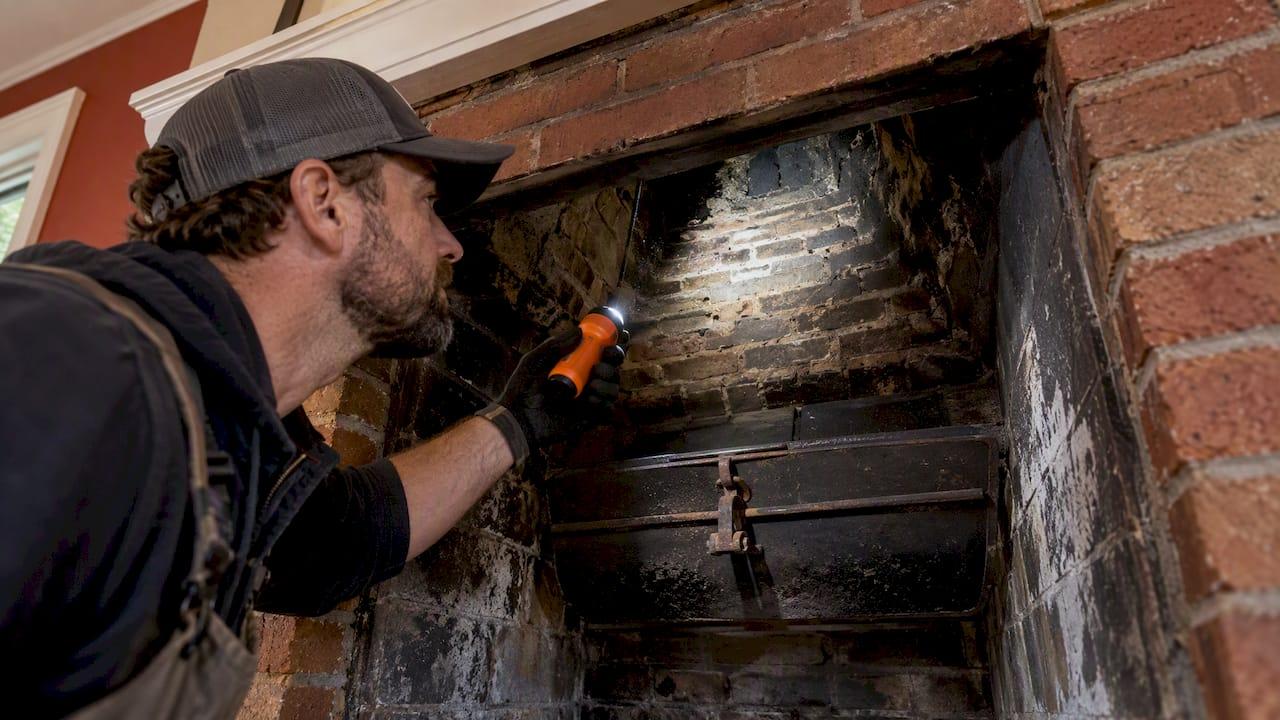
- Inspect. The sweep checks the chamber with a light and mirror or a camera, and records dimensions, wall angle and damage.
- Clean. Soot, creosote and loose material come off. Coating over dirt fails.
- Repair the structure. Missing bricks and mortar joints are fixed first. Parging covers surface roughness. It does not replace a failing structure.
- Apply the coating. Material goes on by hand trowel or by spray, in layers, until the walls are smooth.
- Cure. The coating dries before any fire.
- Verify. A final look confirms full coverage and a clean transition to the flue.
Hand-troweled or sprayed
Both methods are used. Hand parging is the traditional approach. A trowel and refractory mortar go onto the corbelled brick. Some products are rated for several methods. Chamber Safe, for example, is a high-duty refractory parging material that can be cast, parged, troweled, hand-packed or grout-bagged.
Spray systems are the other option. HeatShield's Cerfractory Foam datasheet describes a spray-applied refractory coating that smooths, strengthens and insulates masonry smoke chambers. The sheet says it meets ASTM C199 and is listed to UL Subject 2505. Spray can reach tight, awkward chambers, and it adds insulation.
Which one fits depends on the chamber's shape, its condition and access from the firebox. A good inspection answers that before anyone mixes material.

Why the material matters
Home-center mortar is the wrong product. TCC Materials states that ordinary mortar can deteriorate under high heat. It names medium-duty refractory mortar as appropriate for chimney and smoke chamber use. Its cited product is tested under ASTM C199 to resist temperatures up to 2,550°F for at least six hours.
Ask any contractor what product goes in and whether it is rated for smoke chamber use. A straight answer is a good sign.
Curing time
Do not light a fire early. Refractory mortar has to dry completely before it sees flame. TCC gives a minimum cure of 7 to 10 days for its product, and says actual curing depends on job conditions. Follow the manufacturer's sheet for the product used, and ask your sweep for the go-ahead date in writing.
What smoke chamber repair costs
Prices vary by region and job. Published national figures give a working range.
| Job | Reported U.S. range | Source |
|---|---|---|
| Smoke chamber repair | $500 to $2,000 | Bob Vila, updated October 2023 |
| Smoke chamber parging | $1,000 to $2,000 | Bob Vila, same guide |
| Related labor | $50 to $150 per hour | Bob Vila, same guide |
| Base fee | $50 to $100 | Bob Vila, same guide |
| Scaffolding labor, if needed | $50 to $200 | Bob Vila, same guide |
These are national averages from a 2023 guide, not a quote. Seattle-area labor costs and your chamber's condition can move the number either way.
What pushes the price up or down
- Chamber size. More surface means more material and more time.
- Damage. A chamber with failed old coating or missing mortar costs more than a clean one that needs a fresh coat.
- Access. Tight firebox openings and tall or steep roofs add labor.
- Prep. Cleaning, removing loose coating or rebuilding corbels all add hours.
- Method and material. Hand troweling, spraying and insulating products price differently.
One caution on quotes. A very low price for a "quick coat" may skip the cleaning and structural fixes. Those steps decide how long the repair lasts. Get the scope in writing.
We do not publish set prices for smoke chamber work. Pricing depends on what the inspection finds. We give an upfront quote after we see the chamber.
Can it be a DIY job?
DIY guides exist, and the work looks simple. It is not. The chamber is hard to reach, hard to see and hard to check. A missed gap stays a leak path. A wrong product fails under heat. An early fire on uncured material ruins the coating. This is a fire-safety component. Hire a licensed, insured chimney professional.
When to inspect
CSIA says to have a professional inspect the chimney at least annually, even when use is light. Its guidance, following NFPA 211, covers soundness, deposits and clearances, with cleaning, maintenance and repair as needed.
The levels matter here:
- Level 1. NFPA 211 committee material says a Level I inspection covers internal fireplace and smoke chamber surfaces, checking for damage, deterioration, combustible deposits and operating problems. It fits when conditions are unchanged.
- Level 2. CSIA's Level 2 guide directs inspectors to check the smoke chamber with a light and mirror, record irregularities, assess dimensions and wall angle, confirm whether the walls are parged smooth, and document exposed brick. Smoke chamber condition is part of the full fireplace system, not an optional add-on.
A Level 2 is the right call after a chimney fire, a house purchase, a change of fuel or appliance, or any sign of smoke leakage. Our Level 2 chimney inspection guide explains what it covers and what it costs.
Buying a home with a masonry fireplace? Ask for the inspection before closing. A chamber that was never parged is common in older houses, and it is cheaper to learn that before the keys change hands.
Smoke chamber repair in the Seattle area
Pacific Northwest weather is hard on masonry. Rain pushes into cracked crowns and failed mortar. Water that gets into a chimney can break down joints, and damp, deteriorated masonry is a poor base for a smoke chamber coating. Fix the leak and the chamber together, or the repair will not last.
That often means a package: a smoke chamber coating, a sound flue liner, a good cap and crown, and waterproofing. If you are in Tacoma, see our guide to chimney repair in Tacoma. Renton homeowners can read our chimney repair notes for Renton. We also work in places like Bothell, Shoreline and Duvall.
If the liner is the weak point, see our page on chimney relining. If the brick itself is failing, masonry repair comes first.
Our perspective
We see the same pattern again and again. The homeowner calls about a smoky smell or a stained wall. The firebox looks fine. The problem is above the damper, where nobody looks.
The smoke chamber is easy to ignore and hard to see. That is why we photograph it. Before-and-after photos show what we found and what we fixed. You do not have to take our word for it.
Our approach is simple. Inspect first. Quote upfront. Fix the cause, not just the surface. Clean the chamber, repair what is broken, then coat it with the right refractory product. Then tell the homeowner exactly how long to wait before the next fire.
Pre-season is the best time to do this. Fall and early winter fill the schedule, and our pre-season promotions let homeowners handle safety work at reduced rates. We are licensed, insured and local, and we are available around the clock when something cannot wait.
Do not guess about a chimney. Have it looked at.
Damon
Book an inspection or repair
Not sure what is going on above your damper? Start with an inspection. We check the smoke chamber, flue and firebox, photograph what we find and give an upfront quote for any repair. See our chimney inspection service, or go straight to chimney repair for parging, relining, caps, crowns and waterproofing.

Seattle-area homeowners and property managers can book through Prime Chimney. Do it before the heavy burning season.
FAQ
What is smoke chamber parging?
It is coating the funnel-shaped walls of the smoke chamber with refractory material to make them smooth. Smooth walls cut turbulence, close leak paths and can limit creosote buildup. It is applied by hand or sprayed.
How much does smoke chamber repair cost?
Bob Vila reports a U.S. range of $500 to $2,000, and $1,000 to $2,000 for parging. Size, damage, access and method all move the number. Local quotes are the only real answer, and ours follows an inspection.
How long before I can use the fireplace after parging?
Wait until the coating is fully cured. One manufacturer gives a minimum of 7 to 10 days, and conditions can lengthen that. Ask your sweep for the product's cure time and get the go-ahead before lighting a fire.
Can I use regular mortar to patch the smoke chamber?
No. Ordinary mortar can break down under chimney heat. Use refractory material rated for smoke chamber work and applied by a professional.
How do I know if my smoke chamber needs repair?
Smoke smell, smoke entering the room, soot staining and heavy debris in the firebox are warning signs. Only an inspection can confirm it. A Level 2 inspection looks at the chamber directly.
Sources
- All About Fireplaces, This Old House
- The Parts of a Traditional Fireplace, HowStuffWorks
- Fireplace Smoke Chamber, Smoke Shelf and Damper Design
- CSIA Level 1 inspection of a masonry fireplace
- CSIA Level 2 inspection of a masonry fireplace
- Refractory mortar FAQ, TCC Materials
- Chamber Safe, US Fireplace Products
- HeatShield Cerfractory Foam datasheet
- Chimney repair cost guide, Bob Vila
- Homeowner Resources, CSIA
- NFPA 211 committee input on Level I inspection