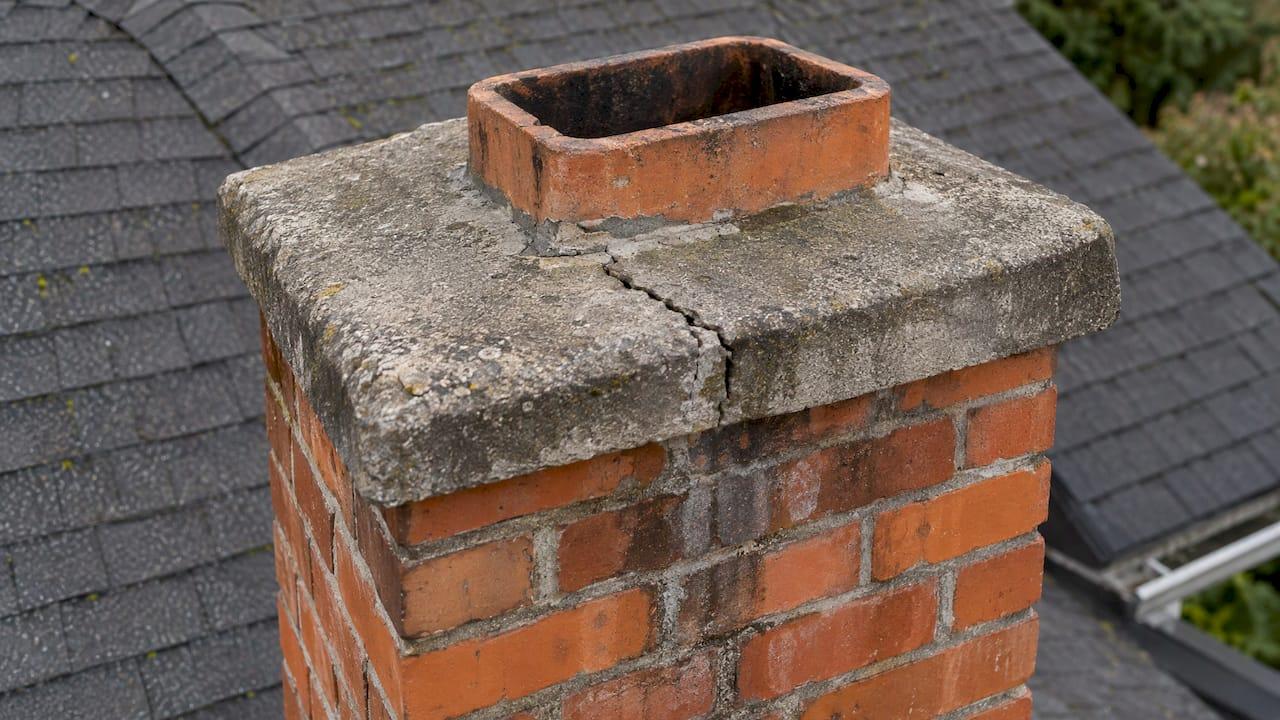
A cracked chimney does not fix itself. Water gets in, mortar softens, bricks loosen. A crack inside the flue is worse: it can let heat and carbon monoxide reach the house. Stop using the fireplace, find out where the crack is, and get it repaired before the next wet season does more damage.
This guide covers what different cracks mean, when a chimney is unsafe, how masonry and flue repairs are done, what they cost, and what insurance usually does and does not cover.
TL;DR
- Cracks in bricks, mortar or the crown let water in. Water damage grows fast. Repair early.
- A cracked flue liner is a fire and carbon monoxide risk. Do not light the fireplace until it is checked.
- Typical costs run from a few hundred dollars for small crack repair to several thousand for rebuilding. Hidden damage drives the final number.
- Insurance usually pays for sudden events, such as a fallen tree or lightning. It usually does not pay for wear, neglect or crumbling bricks.
- A documented inspection shows exactly what is cracked and what needs repair.
Table of Contents
- What a cracked chimney is telling you
- When a cracked chimney is unsafe to use
- Crumbling and falling chimney bricks
- How cracked chimneys are repaired
- What cracked chimney repair costs
- Does homeowners insurance cover a cracked chimney?
- Perspective: why we inspect before we quote
- Get the cracked chimney checked
- How to prevent new cracks
- FAQ
- Sources
What a cracked chimney is telling you
Not every crack means the same thing. Where it sits matters more than how wide it looks.
Hairline cracks in the crown. The crown is the cement cap on top of the stack. It sheds rain away from the bricks. When it cracks, water runs into the masonry and down the inside of the chimney. Family Handyman notes that a cracked crown or spalling bricks can easily cost $1,000 to repair, and that untreated damage can accelerate to upward of $3,000.
Cracked or missing mortar joints. Mortar wears out before brick does. Once joints open, water reaches the brick faces and the inside of the stack.
Cracked or spalling bricks. Spalling is when the face of a brick flakes or pops off. It points to moisture trapped in the brick.
Stair-step cracks or a gap between chimney and house. These suggest movement, often from the footing or a lean. See the guide to leaning chimney repair for causes and fixes.
Cracks inside the flue. These cannot be seen from the roof or the yard. They show up in a camera inspection. They are the most serious kind.

When a cracked chimney is unsafe to use
Do not light a fire if any of these are present:
- Cracks in the flue liner. Bob Vila states that flue liner cracks are dangerous, need repair as soon as possible, and that lighting a fireplace is never recommended with a damaged flue because of the risk of a serious fire.
- A recent chimney fire. House Fire Solutions explains that a chimney fire often cracks the liner and creates a hidden path for carbon monoxide into living space. It says professional testing is the only way to be certain the home is safe.
- Bricks falling from the stack, a visible lean, or a stack pulling away from the house.
- Smoke or soot staining on walls or ceilings near the fireplace.
Use working carbon monoxide alarms on every level while the chimney waits for repair. Call a licensed chimney professional for an inspection. If anyone feels dizzy, has a headache or nausea while a fire burns, leave the house and call 911.
Crumbling and falling chimney bricks
Crumbling bricks and loose mortar are warning signs. They are not cosmetic.
InterNACHI says tall, slender masonry chimneys are the most vulnerable to earthquakes, weathering and wear. That matters in Western Washington, where earthquakes are a real concern. Its inspection checklist includes mortar that crumbles when poked with a screwdriver, missing lateral support such as steel straps, mechanical damage, visible tilting or separation from the building, and defective footings.
Falling bricks are also a roof and yard hazard. Keep people and pets away from the base of the chimney. Keep cars out from under it. If bricks have already dropped, the stack above them is not sound.
A stack that is loose at the top often needs a partial or full rebuild. A stack with failing mortar but solid bricks often needs repointing only. A trained eye separates the two in one visit.
How cracked chimneys are repaired
The repair matches the damage. Here is how each common repair works.
Repointing and crack filling
Repointing replaces failing mortar. This Old House describes the process: remove old mortar with a HEPA-filter grinder, clean out debris, wet the bricks, mix new mortar, apply it with a pointing trowel and smooth the joints. It advises exposing at least three-quarters of an inch to a full inch of depth, because mortar bonds to brick, not to mortar.
The National Park Service sets the depth at 2 to 2-1/2 times the joint width, about 1/2 to 1 inch for most brick joints, to prevent mortar popouts. It also warns that power saws on thin joints almost always damage brick edges, and that hand chiseling poses the least threat to the brick. Careful removal is part of doing the job right.

Crown repair or replacement
Small crown cracks can be sealed. A crown that is crumbling or cracked through needs rebuilding. A proper crown overhangs the stack so water drips clear of the brick.
Cap installation and waterproofing
A chimney cap keeps rain, debris and animals out of the flue. Waterproofing treats the masonry so it sheds water instead of absorbing it. Both protect a repair once it is finished.
Brick replacement and rebuilds
Spalled or cracked bricks are cut out and replaced. When damage runs deep, the top of the stack is taken down and rebuilt with new brick and mortar, with proper support and flashing.
Flue liner repair and relining
Can a cracked flue be repaired? It depends on the liner. House Fire Solutions states that a cracked clay tile liner is not repairable and must be replaced, most reliably with a new insulated stainless steel liner. Relining restores a safe, sealed path for smoke and gases. Details are on the chimney relining page.
If the damage sits in the smoke chamber above the firebox, read about smoke chamber repair.
What cracked chimney repair costs
Prices vary by region, height, access and how far the water has traveled. National figures give a starting range.
| Repair type | Typical national range | Source |
|---|---|---|
| Crack repair (remortaring) | $150 to $500 | Bob Vila |
| Repointing or tuckpointing | $500 to $2,500 | Bob Vila |
| Flue repair | $300 to $2,000 | Bob Vila |
| Rebuilding | $500 to $4,000 | Bob Vila |
| Most repairs overall, 2026 | $500 to $3,500, typical near $1,500 | EstimationPro |
| Average across all repair types | About $750, range $250 to $13,300 | This Old House |
The low end of the flue range is a single tile repair. Major cracks push the number up.
Why two quotes for the same crack can differ
EstimationPro explains that the gap between a $500 job and a $3,500 job comes down to how far water traveled, height and access, mortar condition and what is behind the brick. Hidden damage is the most common reason a bill grows past the first estimate.
That is why a photo-documented inspection matters. It shows what is visible, what is behind it, and why the price is what it is. We publish no flat prices for these jobs, because no two chimneys crack the same way. We give an upfront price once the damage is documented.
For related costs, see chimney cleaning cost and the Level 2 chimney inspection guide.
Does homeowners insurance cover a cracked chimney?
Sometimes. It depends on the cause.
- Covered: sudden, listed events. Policygenius says policies cover chimney repairs when a covered loss caused the damage, such as lightning, fire or a fallen tree.
- Usually not covered: wear and tear or neglect. The same source says fallen bricks and related repairs from normal wear are not covered and would be rejected by most insurers. The New Jersey Department of Banking and Insurance lists wear and tear and maintenance among losses not covered in a standard homeowners summary. Policies differ by state and insurer.
- Limits and deductibles: InsuredBetter notes that reimbursement is up to the dwelling coverage limit, minus the deductible.
- Collapse of a worn chimney: Dick Law Firm says a chimney already in disrepair with crumbling bricks is likely not covered when it collapses, though damage it causes to other property, like a patio, may be.
Read the policy, and ask the insurance agent before filing. After a storm, fire or fallen tree, photos of the damage help. A written inspection report from a licensed chimney company gives the insurer a clear record of what happened and what it will take to fix.
Neglect is the common reason claims fail. Regular inspection is the best protection for the chimney and for any future claim.
Perspective: why we inspect before we quote
Most cracked chimneys we see were not sudden failures. Water got in through a small crack in the crown or a few open joints, and it kept working for years.
The crack on the outside is rarely the whole story. We look inside the flue, check the crown, the mortar, the flashing and the stack's lean. We take photos of each problem so the homeowner sees the same thing we see.
Our approach is simple. Document the damage. Explain the repair that fits it. Give an upfront price. A small repair done early is almost always cheaper than a rebuild done late, and a relined flue is safer than a cracked one.
Seattle-area homes deal with wet weather for much of the year. Waterproofing, a good crown and a proper cap are what keep a finished repair finished.
Damon
Get the cracked chimney checked
Prone to leaks, loose bricks or a flue that has never been inspected? Start with a documented look. Our licensed and insured local team handles chimney inspections, masonry repair and the full range of chimney repair work across the Seattle metro area, including King County, Tacoma and Gig Harbor. Our team is available 24/7, and our inspections come with before-and-after photos.

After a chimney fire, creosote buildup or smoke problems, add creosote removal or a chimney sweep. Pre-season promotions can lower the cost, so book before the heating season starts. Tacoma homeowners can also read about chimney repair in Tacoma. Property managers can book for several units on one visit.
How to prevent new cracks
- Inspect every year. The CSIA, following NFPA 211, says chimneys, fireplaces and vents should be inspected at least once a year for soundness, deposits and clearances. Even a chimney rarely used can have nests or deterioration that make it unsafe.
- Sweep on schedule. The CSIA recommends sweeping a masonry fireplace at 1/8 inch of sooty buildup. Buildup raises the risk of a chimney fire, and a fire cracks liners.
- Keep the crown and cap in good shape. These two parts keep most of the water out.
- Fix small joints early. Repointing a few joints costs far less than rebuilding.
- Add support where needed. InterNACHI recommends steel straps for lateral support and, for earthquake-prone areas, plywood panels attached to the roof or above ceiling joists as a barrier between falling masonry and the roof.
- Schedule a pre-purchase check. A chimney inspection belongs in a home buying review. A cracked stack is a repair bill that a buyer can see before closing.
FAQ
Can a cracked chimney flue be repaired?
It depends on the liner type. A cracked clay tile liner generally has to be replaced, most reliably with an insulated stainless steel liner, according to House Fire Solutions. A camera inspection shows the extent of the cracks. Do not burn fires until the flue is checked.
How much does chimney crack repair cost?
Small crack repair averages $150 to $500 nationally, according to Bob Vila. Repointing runs $500 to $2,500 and rebuilding $500 to $4,000. Local prices depend on height, access and hidden damage. A documented inspection gives an exact price.
Is a chimney with crumbling bricks safe to use?
Not until it is checked. Crumbling bricks and mortar that powders under a screwdriver mean the masonry is failing, and the flue behind it may be damaged. Stop using the fireplace and have a licensed chimney professional inspect the stack.
Is chimney repair covered by homeowners insurance?
Only when a covered event caused the damage, such as lightning, fire or a fallen tree. Wear, neglect and crumbling bricks are typically excluded. Check the policy and talk to the insurance agent before filing a claim.
How often should a chimney be inspected?
At least once a year, according to the CSIA and NFPA 211. Inspect it also after a chimney fire, an earthquake, a major storm or before buying a home.
Sources
- Family Handyman: Chimney Repair and Maintenance
- Bob Vila: Chimney Repair Cost
- House Fire Solutions: What to Do After a Chimney Fire
- InterNACHI: Chimney Inspection, Preventing Collapse
- This Old House: How To Make Common Chimney Repairs
- NPS Preservation Brief 2: Repointing Mortar Joints
- EstimationPro: Chimney Repair Cost in 2026
- This Old House: How Much Does Chimney Repair Cost?
- Policygenius: Does Home Insurance Cover Chimney Damage?
- New Jersey Department of Banking and Insurance: Homeowners Insurance
- InsuredBetter: Does Homeowners Insurance Cover Chimney Repairs?
- Dick Law Firm: Does Your Home Insurance Cover Chimney Damage?
- CSIA: Homeowner Resources