
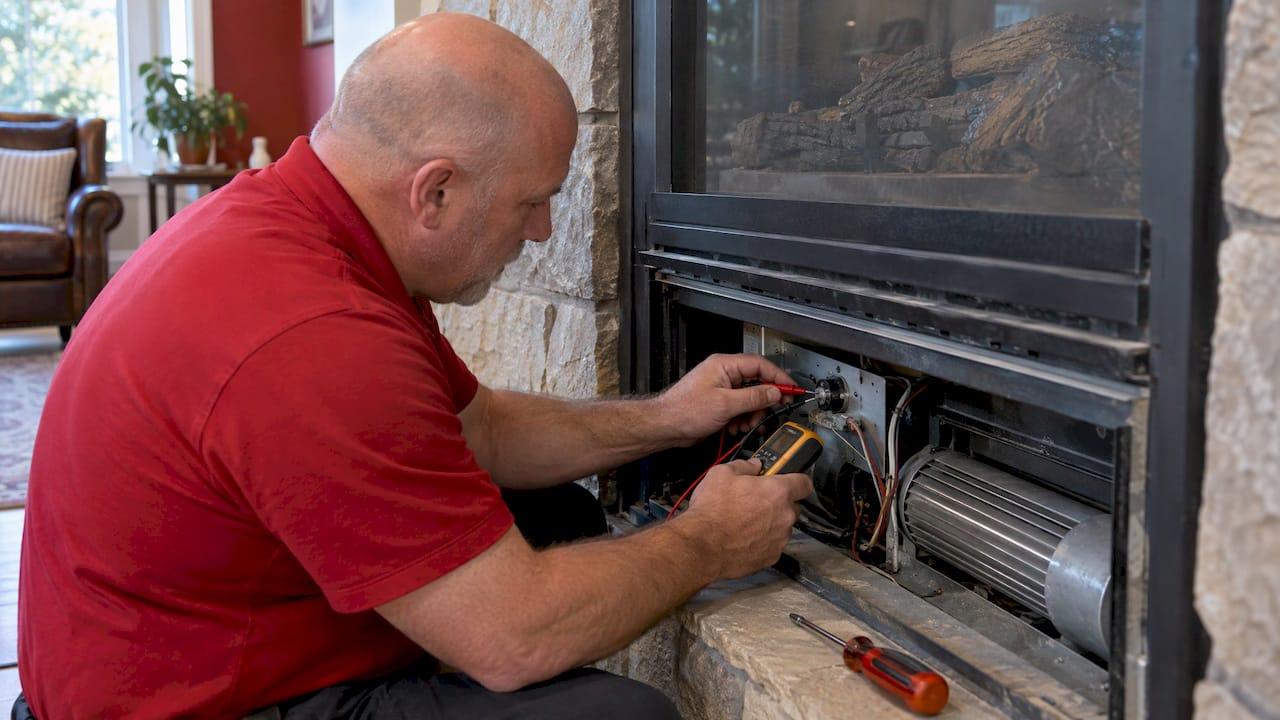
A gas fireplace fan that stays silent, rattles, or never shuts off has a cause. Sometimes it is normal timing. Sometimes it is a failed switch, worn motor, or dust-choked wheel. Know which one before the fireplace runs another night.
This guide covers what is normal, what is a fault, and which problems need a qualified technician. It is written for homeowners and property managers in the Seattle-Tacoma area.
TL;DR
- A blower that starts late or runs after shutdown can be normal. Manufacturers build in a heat-activated delay.
- Real faults include a failed thermal switch, a worn motor, a rubbing or dusty wheel, bad wiring, or a failed control.
- A fan symptom does not prove the gas side is safe. Weak flames, soot, or delayed ignition need service.
- Smell gas? Stop. Shut off the gas, leave, and call the gas supplier or fire department.
- Hardwired blowers, damaged housings, and burn smells are a job for a licensed technician.
Table of Contents
- Is the Fan Broken, or Just Doing Its Job?
- Common Causes by Symptom
- Do Not Treat a Fan Symptom as a Gas Safety Check
- What Homeowners Can Safely Check
- Perspective
- What a Technician Does on a Fan Call
- Repair or Replace the Blower?
- Keeping the Blower Healthy
- Gas Fireplace Service in the Seattle Area
- Get the Fan Fixed Before the Cold Sets In
- FAQ
- Sources
Is the Fan Broken, or Just Doing Its Job?
Start here. Many "broken" blowers are working as designed.
A gas fireplace blower is usually tied to a heat-activated switch. It stays off until the firebox is warm enough to close the switch. That prevents the fan from pushing cold air into the room. One Napoleon manual describes startup delays of about 10 minutes and post-shutdown run times of about 30 to 45 minutes. So a fan that waits, then keeps running after the flames go out, may be fine.
Signs the behavior is normal:
- The fan starts several minutes after ignition.
- It keeps running after the burner is off, then stops on its own.
- It speeds up or slows down as the unit warms and cools.
Signs it is not normal:
- The fireplace has been burning well past the expected delay and the fan never starts.
- The fan runs for hours after the unit is completely cold.
- It hums but does not spin.
- It grinds, squeals, or rattles.
- It starts and stops on its own.
Models differ. The model number is usually on the rating plate in the control area, and the owner's manual is the model-specific source. Majestic's manual says this and sends owners to the dealer for service questions.
Common Causes by Symptom
The same symptom can come from several faults. This table shows the usual suspects. It is a map for the conversation with a technician, not a repair procedure.
| Symptom | Likely causes |
|---|---|
| Fan never starts | Failed thermal switch, interrupted power, bad wiring, dead motor, faulty speed control or switch |
| Fan hums but does not spin | Failing or seized motor, stuck blade, supply or control problem |
| Loud rattle, grind, or squeal | Dust on the wheel, wheel rubbing, loose mounts, worn bearings, overheating motor |
| Weak airflow | Dust and pet hair, blocked wheel, motor losing power |
| Fan will not shut off | Thermal sensor stuck closed, shorted wiring, failed relay or control module |
| Fan cuts in and out | Loose or heat-damaged wiring, faulty control, unstable power |
The causes above are consistent with this diagnostic overview and with troubleshooting notes on a fan that runs after the unit is cold.
Fan Won't Start
The thermal switch is the most common culprit. If it fails open, the fan never gets its start signal, even with a hot fire. Wiring is next. Heat and vibration loosen connections over the years. Then comes the motor itself.
A technician checks the power feed, the switch, the controls, and then the motor. Order matters. Replacing a motor when the switch is bad wastes money.
Fan Is Loud
Dust is the first suspect. Dust and pet hair load the wheel, raise heat, and add noise. Renovation dust is worse. Napoleon warns that drywall dust can enter bearings, which can turn a cleaning job into a dead motor.
Worn bearings produce a grind or squeal. A wheel that touches its housing produces a rattle or scrape. Loose mounts add a buzz. Each has a different fix, so the sound helps, but the diagnosis comes from looking at the unit.

Fan Won't Shut Off
A fan that runs well after the fireplace is cold points to a stuck sensor, shorted control wiring, or a failed relay or control module. A blower running all night is not just noise. It means a part is failing and may take other parts with it.
Do Not Treat a Fan Symptom as a Gas Safety Check
A working fan says nothing about the burner. A silent fan says nothing about it either.
Watch the flame and the area around the unit. These signs point to a combustion or venting problem, not a fan problem: weak flames, delayed ignition, pilot outages, soot, an odd flame appearance, or venting concerns. That same diagnostic guide says a fan symptom should never be read as proof the gas side is fine. If the pilot is the issue, see our guide on gas fireplace pilot light repair.

If You Smell Gas
Stop. Do not use the fan, the switches, or the remote.
The Napoleon GB20 manual lists the steps:
- Turn off all gas to the fireplace.
- Open windows.
- Do not try to light any appliance.
- Do not touch any electric switch.
- Do not use a phone in the building.
- Call the gas supplier from a neighbor's phone, or call the fire department.
The Empire installation instructions say the same: leave the area and call from outside. Our page on what to do when a gas fireplace smells like gas goes through it in more detail.
Other Reasons to Keep the Fireplace Off
- The glass is cracked or broken, or the unit has been under water. One manufacturer's manual requires qualified service before it is used again.
- A safety screen, guard, or front panel was removed. It must go back on before the fireplace runs.
- You see burning plastic, melted insulation, or scorch marks near the blower.
What Homeowners Can Safely Check
A few checks carry no gas risk and take minutes. Keep them to the outside of the unit.
- Give it time. Let the fireplace run through its normal warm-up before deciding the fan is dead.
- Check the wall switch and remote. Some units have a separate blower switch, and remotes run on batteries.
- Check the breaker and any GFCI outlet that feeds the unit.
- Listen. Humming without spinning points to a motor or stuck blade. Grinding points to bearings.
- Note what you see and hear. Write down when the fan starts, when it stops, and the noise. A technician can use all of it.
That is where the homeowner checklist ends. Opening the unit, testing electrical parts, and working near the burner compartment belong to a qualified technician. Manufacturer guidance, including Majestic's owner's manual, says installation and service should be done by qualified personnel.
Some blower drives store a charge, too. Lennox's service manual warns that a lit red LED means the capacitor is charged and nothing should be touched until it goes out. That is one more reason to let a trained person open the cabinet.
Perspective
We get the same call every fall. The fan has been dead since last winter, nobody noticed, and now the room never warms up.
Here is what we see in the field. The fan is rarely the whole story. A blower that quits is often sitting in a unit full of dust, with a tired switch, and a burner that has not been looked at in years. Fix only the fan and the next problem is waiting.
That is why our gas fireplace work starts with a diagnosis, not a part swap. We check the power feed, the switch, the controls, and the motor. We also look at the burner, the flame, and the venting. Our inspections are photo-documented, so you see what we see.
Pricing should be clear before work starts. That is our standard. Our technicians are licensed and insured, and we are available around the clock for urgent problems.
A fan that fails is a warning. Book the visit before the first cold week, not during it.
Damon
What a Technician Does on a Fan Call
A proper service visit follows a sequence. Skipping steps leads to wrong parts and repeat visits.
- Confirm the model and the manual. The rating plate tells the technician which blower, switch, and controls belong to the unit.
- Observe the fault. Does the fan start? When? Does it stop? What does it sound like?
- Check power and controls. The supply, the wall switch, the speed control, and the wiring.
- Test the thermal switch. This decides whether the fan gets the start signal at all.
- Inspect the blower assembly. Wheel, housing, mounts, and bearings, plus dust and pet hair.
- Test the motor. Manufacturer service documents give pass and fail readings. Lennox's manual, for example, says a motor with less than 100k ohms from a lead to chassis ground should be replaced.
- Check the gas side. Flame, pilot, ignition, and venting. A fan call is a good moment to catch a burner issue early.
- Replace the safety parts and test. Any screen or guard comes back on, then the unit runs through a full heat cycle.
The annual check matters here too. The Napoleon manual says the fireplace and venting should be inspected before use and at least annually by a qualified service person, and that the control compartments, burners, and circulating blower passageway must be kept clean.
Repair or Replace the Blower?
The choice depends on what failed.
Repair makes sense when the problem is a switch, a connection, a control, or a dust-loaded wheel. The motor is fine and the housing is sound.
Replacement makes sense when the motor has failed, the bearings are worn out, the wheel is damaged, or the assembly is simply at the end of its life. A worn motor often returns as a noisy fan within months if only cleaned.
Call a professional first when:
- The blower is hardwired.
- The housing is damaged or corroded.
- You see burning plastic, melted insulation, or other signs of electrical damage.
Those are the cases one hearth retailer's guide flags for professional help.
We give you the repair-or-replace answer before work begins, with the reason for each. Price depends on the model, the part, and the access, so we quote after we diagnose.
Keeping the Blower Healthy
A few habits cut down on fan trouble.
- Schedule an annual service before the heating season. Dust and worn parts show up before they fail.
- Protect the unit during remodeling. Cover the fireplace when sanding drywall or running saws nearby.
- Vacuum the room, not the unit. Pet hair and lint settle fast. Leave the cabinet to the technician.
- Act on early noise. A new squeal is cheaper than a seized motor.
- Keep the chimney side in shape. Venting, caps, and crowns affect how the whole system runs. Our chimney cleaning cost guide explains what a sweep includes.
If the unit is a vented gas or wood-burning setup with a masonry chimney, a chimney inspection can cover the venting at the same visit.
Gas Fireplace Service in the Seattle Area
Our work covers the Seattle metro area, including King County, Tacoma, and Gig Harbor. Wet Pacific Northwest winters mean fireplaces run hard from fall through spring, and a dead blower is felt fast. If you are in Pierce County, our guide to gas fireplace repair in Tacoma covers signs and next steps. For chimney-side issues, see chimney repair in Tacoma.
Get the Fan Fixed Before the Cold Sets In
Prime Chimney repairs and diagnoses gas fireplaces across the Seattle metro area. We check the fan, the controls, and the gas side in one visit. Our technicians are licensed and insured, and we document inspections with photos. You can reach us any time for urgent problems.

Ready to book? See our gas fireplace and chimney repair services, or start at Prime Chimney.
FAQ
Why is my gas fireplace fan not working?
It may not be warm enough yet. Many blowers wait for a heat-activated switch to close, and manufacturers describe delays of about 10 minutes. If it still does not start, the cause may be the switch, power supply, wiring, controls, or a failed motor. A technician can tell which one in a single visit.
Why is my gas fireplace blower so loud?
Usual causes are dust on the wheel, a wheel rubbing its housing, loose mounts, or worn bearings. An overheating motor can also add noise. Grinding or squealing that gets worse over time means the motor is wearing out. Have it looked at before it seizes.
Why does the fan keep running after the fireplace is off?
Some run-on is normal. One manufacturer describes post-shutdown operation of about 30 to 45 minutes. If the fan runs for hours after the unit is cold, a sensor may be stuck closed, or the wiring or control module may have failed.
Can I fix a gas fireplace fan myself?
Simple checks like the wall switch, remote batteries, and breaker are safe. Anything past that involves electrical parts inside a gas appliance. Manufacturers say electrical service and repair are qualified-technician tasks. Call a pro for hardwired blowers, damaged housings, or any burning smell.
Is it safe to use the fireplace with a broken fan?
That depends on why the fan is not running and what the burner is doing. A dead fan does not prove the gas side is safe. If you see soot, weak flames, delayed ignition, or smell gas, stop using the unit and call for service.
Sources
- Napoleon gas-fired wall furnace manual
- Napoleon GD45 manual
- Napoleon GB20 owner's manual
- Majestic Meridian owner's manual
- Empire installation instructions
- Direct vent fireplace installation and operating manual
- Lennox blower drive service manual
- Gas fireplace fan repair diagnostic overview
- Gas fireplace blower fan troubleshooting
- Gas fireplace blower not working: troubleshooting and replacement