
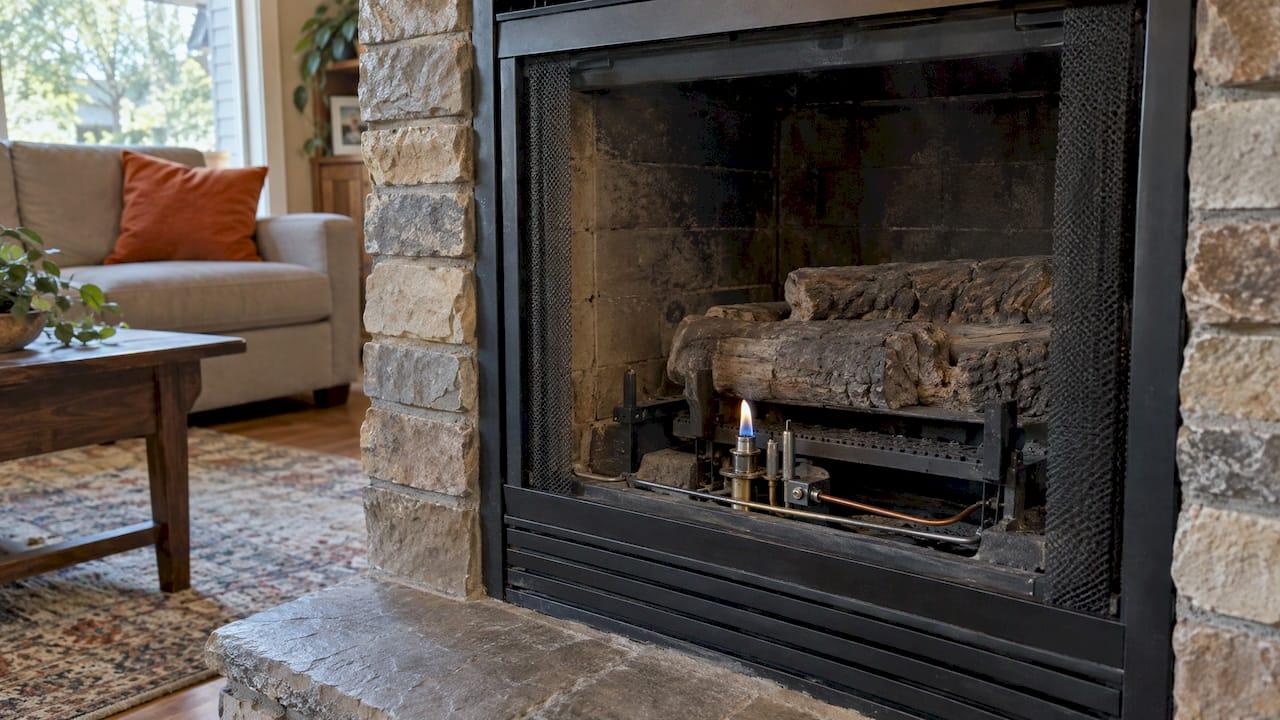
A gas fireplace pilot that lights, then dies, is almost always a sensor problem. The usual culprit is a dirty, misaligned or worn thermocouple. A weak thermopile, a drafty flame or a clogged pilot assembly can cause the same thing. Each one cuts the gas for a reason. The pilot is a safety system. When it shuts the gas off, it is doing its job.
Don't keep relighting it. Find the cause. Fix it right.
TL;DR
- The most common cause of a pilot that won't stay lit is a dirty or faulty thermocouple, the part that senses the flame and lets gas flow.
- Thermopile trouble, a weak or misplaced flame, drafts and valve faults produce the same symptom.
- Smell gas? Leave the house, then call 911 or the gas utility. Do not try to relight.
- If the pilot fails after several tries, stop and book a qualified technician.
- Typical repair for a thermocouple runs $100 to $300 with parts and labor, according to one HVAC contractor quoted by House Digest.
Table of Contents
- Why a Gas Fireplace Pilot Keeps Going Out
- The Common Causes
- Quick Reference: Symptom, Likely Cause, Who Handles It
- What a Homeowner Can Look At Safely
- Gas Smell or Carbon Monoxide: Stop Everything
- What a Technician Does
- What Pilot Repair Usually Costs
- Chimney Problems That Cause Pilot Trouble
- Perspective
- Get the Pilot Fixed Properly
- When to Stop and Call
- Keeping the Pilot Lit Season After Season
- FAQ
- Sources
Why a Gas Fireplace Pilot Keeps Going Out
A standing pilot is a small flame that stays on to ignite the main burner. A sensor watches that flame. If the sensor stops reporting heat, the gas valve closes. That is the design.
Two parts matter most:
- Thermocouple. It detects heat and keeps the pilot on. When it is dirty or failing, the signal drops and the gas shuts off.
- Thermopile. It allows gas to flow to the main burner. If it malfunctions, the fireplace can keep going out.
The symptom looks the same for many causes. That is why guessing fails. Replacing the wrong part wastes money and leaves the problem in place.
The Common Causes
Dirty or Worn Thermocouple
Soot, dust and corrosion build up on the thermocouple tip. A dirty, misaligned or faulty thermocouple may not generate enough voltage to keep the gas valve open. The pilot lights while the knob is held down. It dies the moment the knob is released.
That pattern points to the thermocouple. It is the single most common finding.
Flame Not Touching the Sensor
The pilot flame must cover the sensor tip. Valor's homeowner documentation says the pilot flame must cover the tip of the thermocouple probe. Empire's manual says that if the flame is not close enough to the thermopile, the pilot can burn out, and the pilot flame should be adjusted for better contact.
A flame pushed off the sensor by a clogged pilot orifice or low gas pressure will do this. A steady blue flame that wraps the tip is the target. A weak or yellow flame points to a dirty pilot assembly or a supply issue.
Weak Thermopile
Many gas fireplaces run on millivolts. The thermopile makes the power that holds the valve open. Empire's manual says a thermopile system should read a minimum of 350 millivolts at the valve terminals with the pilot lit and the knob held in the PILOT position. Below that, the thermopile gets replaced.
This is a meter test. It needs the right tool and the right terminals. It is a technician task.
Drafts and Airflow
A gust can blow out a small flame. A downdraft, a leaky damper area, a failing vent connection or a tight house under exhaust fan pull can all disturb the pilot. One HVAC expert quoted by House Digest suggests running a hand around the appliance to feel for airflow that could put the pilot out.
In a chimney-vented fireplace, airflow trouble often starts above the firebox. A blocked flue, a damaged cap or a drafty smoke chamber can all change how the appliance breathes. That is why a fireplace pilot problem sometimes ends in a chimney inspection.

Faulty Gas Valve
Sometimes the sensor is fine and the valve is not. Empire's troubleshooting calls for replacing the thermocouple when the reading is below 15 millivolts, and for replacing the valve if the thermocouple output is above 15 millivolts and the pilot still drops. A good sensor with a bad valve is a repair homeowners cannot diagnose by eye.
Loose Connections
The thermocouple must be seated properly at the valve. One manufacturer's manual says it should be attached finger-tight plus 1/8 turn with a wrench, and that a millivolt reading above 14 mV is required or the thermocouple gets replaced. Too loose and the signal is poor. Too tight and the part can be damaged.
Quick Reference: Symptom, Likely Cause, Who Handles It
| What you see | Likely cause | Next step |
|---|---|---|
| Pilot lights, dies seconds after the knob is released | Dirty, misaligned or worn thermocouple | Technician inspection and test |
| Weak, small or yellow pilot flame | Clogged pilot assembly or low gas pressure | Technician cleaning and pressure check |
| Pilot goes out in gusts or when fans run | Draft, vent or chimney airflow problem | Fireplace and chimney inspection |
| Strong pilot, fireplace still shuts down | Weak thermopile or faulty gas valve | Millivolt testing by a technician |
| Gas odor at any point | Possible leak | Leave, call 911 or the gas utility |
What a Homeowner Can Look At Safely
Keep this short. Look. Do not take apart.
- Check the flame. A steady blue flame covering the sensor tip is normal. Yellow, tiny or lifting flame means service.
- Check the gas valve setting. One common cause is a valve left in the wrong position. If the control is off, the fix is simple. If it is on and the pilot still fails, move on.
- Note the pattern. Does the pilot die instantly when the knob is released? Does it hold for a minute, then fail? Does it fail only when the wind blows? A technician uses this.
- Note the last service. A fireplace that has not been cleaned or inspected in years is a prime suspect for soot and debris.
One HVAC expert describes a basic test: light the pilot, hold the gas valve knob for 30 seconds, then release. If the flame dies instantly, the thermocouple likely needs attention. That tells the technician where to start. It does not replace a proper diagnosis.
Relighting: Follow the Label
Every fireplace lights differently. Some use a knob and a match. Others use a built-in igniter. Some are electronic and have no standing pilot at all. The correct procedure is on the instruction plate or in the manual for that unit. Follow it exactly.
Do not relight if there is any gas smell. Do not force a knob. Do not repeat the process again and again. Valor's documentation says that if the pilot does not stay lit after several tries, call a local service technician or the gas supplier.

Gas Smell or Carbon Monoxide: Stop Everything
This is the one case where speed matters more than anything else.
- Smell gas: don't touch switches or devices. Get out, stay out, and call 911.
- Do not use a phone inside the home. Call from outside.
- Do not relight the pilot. Do not run the fireplace until it has been checked.
- Working smoke and carbon monoxide alarms belong on every level of the home. The Massachusetts State Fire Marshal advises testing them every month and replacing CO alarms after 5, 7 or 10 years, depending on make and model.
A pilot that keeps dying can leave unburned gas near the unit for a short time. Do not treat it as a nuisance. Read more in our guide on what to do if a gas fireplace smells like gas. In the Seattle area, the gas bill names the utility to call. When unsure, call 911.
What a Technician Does
A proper pilot repair is a sequence, not a guess.
- Observe the failure. Light the pilot and watch the flame, the hold time and the shutdown.
- Inspect the pilot assembly. Clean soot, dust and debris. Check the orifice and the flame shape.
- Check flame contact. The flame must reach the thermocouple or thermopile the way the manufacturer specifies.
- Test millivolt output. The reading tells whether the sensor or the valve is at fault.
- Check venting and draft. Look at the flue path, damper, cap and connections.
- Replace the failed part. Then relight, test the cycle and confirm the pilot holds.
That order matters. Replacing a thermocouple when the valve is the problem means a second visit. A meter reading prevents it.
What Pilot Repair Usually Costs
Most pilot problems are small repairs. A thermocouple is cheap as a part. Labor and diagnosis make up the rest. David Lewis of Mission AC & Plumbing told House Digest that the part is typically under $30, and part plus labor lands between $100 and $300.
The bill rises when the fault is deeper: a thermopile, a gas valve, a damaged vent connection or a chimney issue that causes the draft. We do not publish set prices for fireplace work. The scope depends on the unit, the fault and the access. Our crew gives upfront pricing once the cause is confirmed. For a deeper look at what drives the number, see our guide to gas fireplace pilot light repair, causes and costs.
Chimney Problems That Cause Pilot Trouble
A vented gas fireplace depends on the chimney. If the flue is blocked or damaged, the appliance can act up in ways that look like a pilot fault.
- Blocked or partly blocked flue. Nesting debris, fallen mortar and old creosote from a previous wood-burning life of the fireplace can restrict flow. Our creosote removal service handles that buildup.
- Missing or damaged cap. Wind and rain get in. Seattle-area rain is hard on exposed chimneys. Water entry leads to rust, damp debris and drafts.
- Failed liner. A cracked or deteriorated liner can disturb venting and cause safety trouble well beyond the pilot.
- Crumbling crown or masonry. Water gets in and the whole system degrades. Look at smoke chamber repair signs when the airflow trouble is internal.
A gas appliance that is repaired but vents into a damaged chimney will fail again. Diagnosis has to cover both.
Perspective
A pilot that won't stay lit is a warning, not an annoyance. We see the same pattern often: a homeowner relights it again and again, it holds for a day, then it drops. Each retry hides the real cause.
Our approach is simple. Find the weak spot. Test the sensor. Test the valve. Check the flame. Check the chimney above it. Then fix the one thing that is actually wrong.
We photo-document our inspections so the homeowner sees what we see. Upfront pricing follows the findings, not the other way around. Our team is licensed and insured, and we are available around the clock for urgent problems, because a gas issue does not wait for business hours.
If the pilot won't hold, do not wait for cold weather. Book the visit early in the season, when schedules are open and pre-season promotions can reduce the cost.
Damon
Get the Pilot Fixed Properly
Prime Chimney serves homeowners and property managers across the Seattle metro area, including Tacoma and Gig Harbor. Our crews handle gas fireplace diagnostics and repair, plus the chimney work that sits behind many pilot problems: inspections, sweeps, relining, cap and crown work and waterproofing.

Start with a chimney inspection when the cause is unclear or the chimney has not been checked in years. For a failed sensor, valve or other fireplace fault, see our gas fireplace and chimney repair services. Tacoma homeowners can also read about gas fireplace repair in Tacoma.
When to Stop and Call
Call a qualified technician when:
- The pilot fails after several relight attempts.
- The flame is yellow, weak, lifting or noisy.
- The pilot lights only while the knob is held down.
- Soot appears on the glass or around the unit.
- The fireplace has not been serviced in more than a year.
- A gas odor shows up at any time. In that case, leave first, call second.
Napoleon, a fireplace maker, recommends that troubleshooting and repair of a failing thermocouple or thermopile go to a certified fireplace service technician. That fits what we see in the field. The part is small. The consequence of a wrong guess is not.
Keeping the Pilot Lit Season After Season
- Schedule a yearly inspection and cleaning. Soot and dust are the enemy of every pilot assembly. Napoleon recommends keeping the thermocouple and thermopile clean.
- Book before the cold arrives. Fall demand fills schedules fast.
- Keep the area around the unit clear. Rugs, curtains, boxes and storage should stay away.
- Keep the chimney sound. A sound cap, crown and liner protect the venting path. A regular chimney sweep clears debris that can disturb airflow.
- Keep the manual. The model number and instruction plate speed up every repair.
FAQ
Why does my gas fireplace pilot light go out when I let go of the knob?
That points to the thermocouple. It may be dirty, misaligned or worn, and it is not telling the valve that the flame is present. A technician can clean it, check the flame contact and test the millivolt output to confirm.
Can wind or a draft put out the pilot?
Yes. Airflow from the vent, a damaged cap, a leaky flue or exhaust fans in a tight house can blow out a small flame. If the pilot fails only in certain weather or when fans run, a fireplace and chimney inspection finds the path.
Is it safe to keep relighting the pilot?
No. Follow the label for one careful attempt. If it does not hold after several tries, stop and call a technician. Never relight if you smell gas. Leave the house and call 911 or the gas utility from outside.
How much does it cost to fix a pilot light that won't stay lit?
A thermocouple replacement commonly runs $100 to $300 including labor, per one contractor's estimate. Thermopile, valve or venting repairs cost more. The cause decides the price, which is why diagnosis comes first.
Does the same advice apply to a furnace or a water heater?
The basic idea is the same: a flame sensor controls the gas. The parts, procedures and safety steps differ by appliance. For a gas fireplace in the Seattle area, our team can diagnose it. For a furnace or water heater, use that appliance's manual or the right trade.
Sources
- 5 Reasons the Pilot Light Won't Stay on in Your Gas Fireplace, Do It Yourself
- Why Your Gas Fireplace Keeps Going Out, Napoleon
- Top Reasons Why Your Gas Pilot Light Keeps Going Out, House Digest
- Empire installation instructions and owner's manual
- Valor homeowner documentation, Legend G3.5
- Valor homeowner documentation, Linear Series
- Hearth & Home Outdoor Lifestyles 4072-180 installation manual
- Massachusetts State Fire Marshal home heating reminder