Brick chimney repair starts with a diagnosis. Crumbling mortar, cracked or flaking brick, and a damaged crown or cap each call for a different fix. Small repairs cost a few hundred dollars. Waiting turns them into rebuilds. In wet Seattle-area weather, water is the usual cause. A licensed mason who documents the damage with photos can tell you which repair you need before any work begins. Prime Chimney provides inspections and masonry repairs for homeowners in the Seattle metro area.
TL;DR
- Loose or missing mortar, flaking or cracked brick, white staining and a cracked crown are the main signs a brick chimney needs repair.
- Repointing (replacing worn mortar joints) is the most common masonry chimney repair. Done early, it prevents brick replacement and rebuilds.
- National cost estimates for 2026 run from about $200 for a crown seal to $4,000 to $15,000 for a full rebuild. Damage type, height and access set the price.
- Hard, wrong-type mortar and sealing in moisture both make brick decay faster. Method matters as much as materials.
- A Level 2 inspection or a photo-documented assessment shows which repair you need before you spend money.
Table of Contents
- Signs your brick chimney needs repair
- How brick chimney repair is done
- Repair or rebuild?
- What brick chimney repair costs
- How to decide what to do first
- Keeping a repaired chimney in good shape
- Our approach to brick chimney repair
- Book a chimney inspection or repair
- FAQ
- Sources
Signs your brick chimney needs repair
Look from the ground first. Then look again after a hard rain. Water is the enemy of brick, and most chimney damage starts with it.
The U.S. National Park Service says exposed masonry should be inspected periodically for cracking, spalling, bowing, leaning and mortar deterioration. Spalling means the face of the brick flakes or peels off. Here is what each sign tells you.
- Crumbling or recessed mortar. Mortar joints that are sandy, cracked or sunken let water into the wall. This is the most common problem and the cheapest to fix early.
- Flaking, cracked or missing bricks. Water has been inside the brick, and the face is breaking away.
- White powdery staining. This is efflorescence, salt left behind as moisture moves through the masonry. It means water is getting in. It is not the damage itself, but it points to where the damage is.
- A cracked or crumbling crown. The crown is the concrete or mortar slab across the top that sheds water away from the brick. When it cracks, water runs straight down into the chimney.
- A leaning or tilted stack, or gaps at the roofline. These are structural signs. They need a professional, not a patch.
- Water stains on the ceiling or walls near the fireplace, or rust in the firebox. Moisture is getting past the masonry and into the house.
Inspection checklists used by professional home inspectors cover the same list: efflorescence, rusted dampers, deteriorated mortar joints, a cracked flue lining, a tilted stack and water stains. Many of these signs can't be seen from the ground, which is why a roof-level look matters.
Safety risks inside the chimney
Some damage is invisible from outside. A Connecticut Department of Consumer Protection guide says a sweep should check for damaged brick and missing or crumbling mortar in the firebox, broken or damaged flue liners, and creosote deposits thicker than 1/8 inch. It also notes that vertical cracking in the flue liner is a sure sign of a previous flue fire and needs repair.
Creosote is the tar-like residue wood smoke leaves inside a flue. It burns. Cracked liners and open joints give heat and smoke a path toward the wood framing of your home. If you smell smoke in odd places, or see daylight or cracks inside the flue, stop using the fireplace until a professional has looked at it.
If your chimney serves a gas fireplace, the same masonry rules apply. Water damage, a failing liner or a blocked flue can all affect how safely a gas appliance vents.

How brick chimney repair is done
The repair depends on what the inspection finds. Here are the repairs in the order a mason normally works through them. The National Park Service notes that structural repairs come before minor or cosmetic ones.
Repointing (tuckpointing)
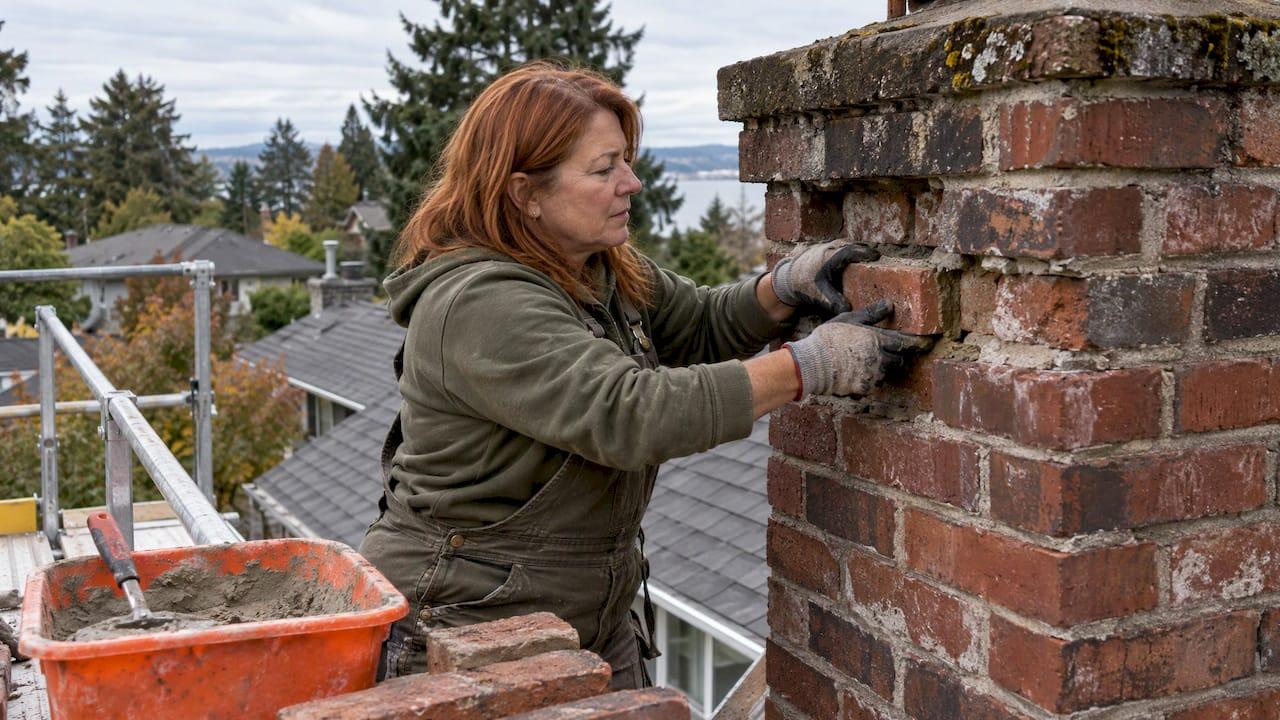
This is the repair most brick chimneys need. The Heritage Home Program calls repointing, also called tuckpointing, the most common masonry chimney repair. The mason removes loose mortar and packs in new mortar.
The details decide whether the repair lasts:
- Depth. Fine Homebuilding recommends cutting old mortar out to twice the joint height. For a 3/8 inch joint, that is 3/4 inch. Cutting past one-third of the joint's depth risks destabilizing the brick. Shallow work peels out within a few seasons.
- Mortar type. The Heritage Home Program says repointing should follow National Park Service standards: a high-lime, low Portland cement mix. The Park Service warns that hard mortars with a lot of Portland cement are less permeable than the brick around them and will often make the surrounding masonry deteriorate faster.
- Removal method. Fine Homebuilding explains that when mortar is harder than the brick, the brick can spall and crack just from normal expansion and contraction. Chiseling out old hard mortar can do the same damage faster, because hammer energy travels through the mortar and into the soft brick. This Old House describes using a grinder with a HEPA dust filter, then cleaning out the joints, wetting the brick and finishing the new mortar with a pointing tool.
This is why a cheap, fast repointing job can cause more harm than it fixes. Ask any contractor which mortar mix they use and how deep they cut.
Replacing damaged bricks
When a brick has lost its face or cracked through, repointing alone won't save it. The mason cuts out the damaged brick, then sets a matching replacement in fresh mortar. Matching size, color and hardness matters, because a brick that is too hard or too soft will fail next to its neighbors. Replacing a handful of bricks is a modest job. Replacing large areas is a sign the wall is failing.
Crown repair and chimney caps
The crown and cap protect everything below them. A hairline crown crack can be sealed. A crumbling crown needs a tear-off and a new pour. The Heritage Home Program suggests that when a crown or cap is rebuilt, a precast concrete or stone option is more durable than a cast-in-place mortar wash, and that a precast cap should overhang the masonry with a drip edge so water falls clear of the brick.
A chimney cap on top of the flue keeps rain and animals out. Newer building codes also set cap and spark-arrestor details. The 2021 International Residential Code calls for a sloped cap with a drip edge and a screen with openings between 3/8 and 1/2 inch.
Flashing, waterproofing and the roofline
Many "chimney leaks" are actually flashing problems, the metal that seals the chimney to the roof. Water that gets in there stains ceilings and rots framing, and it keeps soaking the brick. For a deeper look at causes and fixes, see this guide to a roof leak around the chimney.
Be careful with waterproofing products. The National Park Service warns that coating a badly deteriorated brick wall with chemicals or non-permeable paint accelerates decay by trapping moisture behind the coating. If a coating is truly necessary, a water-permeable one works best. Brick needs to breathe. The right fix is to stop water at the crown, cap, flashing and joints, then let the wall dry out.
Liner repair
If the flue liner is cracked, the fix is a repair or a new liner, not a cosmetic patch. A damaged liner is a fire and carbon monoxide concern, and it is a separate job from repointing the outside. See the smoke chamber repair guide for the part of the flue just above the firebox, which is often overlooked.

Repair or rebuild?
Most chimneys can be repaired. A rebuild becomes the answer when the structure itself has failed.
Signs a chimney is heading toward a rebuild:
- Bricks are loose or falling over a large area, not in a few spots.
- The stack leans or has separated from the house.
- Mortar has failed so widely that repointing would mean redoing most of the wall.
- Repeated repairs in the same area keep failing.
A Delaware County planning guide describes the standard approach to a structural lean: take the chimney down to the first sound course of brick and rebuild from there. Often only the top section above the roofline needs to come down. That is a partial rebuild, and it costs less than a full one.
The same guide explains why chimneys crack. Flue heat makes mortar expand in winter, then cold makes it contract, and sun-facing sides contract more slowly than shaded ones. Over years, that movement opens cracks. For more on those cracks, read our guide to cracked chimney repair. If the stack is out of plumb, see leaning chimney repair.
What brick chimney repair costs
Costs vary a lot by the damage, the chimney height and the access. These are national estimates, not Seattle quotes or Prime Chimney prices. Treat them as a range for budgeting.
| Repair | Typical national range (2026) |
|---|---|
| Cracked crown seal | $200 to $500 |
| Spalling crown or cracked flue liner | $500 to $1,500 |
| Tuckpointing the chimney | $500 to $2,500 |
| Partial rebuild of the top section | $1,000 to $3,500 |
| Flue liner replacement | $900 to $7,000, average $2,500 |
| Leaning chimney repair | $3,000 to $9,000 |
| Full rebuild | $4,000 to $15,000, average $9,000 |
What moves the price:
- Height and access. Bob Vila's budget guide puts labor at $50 to $150 per hour, with $50 to $200 more if scaffolding is needed. Tall chimneys add 20 to 40 percent for scaffold time and risk, according to CurrentCost's leaning chimney estimates, and foundation underpinning can add $1,000 to $4,000.
- How much brick is damaged. Ten bad bricks and a hundred bad bricks are different jobs.
- Urgency. The same Bob Vila guide says emergency repair fees add $100 to $300 to the standard price.
- Waiting. Water damage compounds. A repointing job becomes brick replacement, and brick replacement becomes a rebuild.
Prime Chimney doesn't publish fixed prices for repairs, because the price depends on what the inspection finds. Our approach is upfront pricing after the damage is documented with photos.
How to decide what to do first
Start with an inspection, not a repair quote. A repair you can't see is a repair you can't judge.
- Get the chimney inspected. A Level 1 inspection covers the accessible parts of a chimney that is working normally. A Level 2 inspection adds a camera look inside the flue, and it is the usual choice when buying a home or after a fire, a storm or a change in how the fireplace is used. Read our Level 2 inspection guide for what it covers.
- Ask for photos. Photos show the mortar, the crown and the liner as they are. They also let you compare before and after.
- Ask what is structural and what is cosmetic. Structural repairs come first, as the Park Service advises.
- Ask about the mortar and method. Ask what mortar mix is used and how old mortar is removed.
- Plan around the season. Fall is when chimneys get used and when repair schedules fill up. Repairs done before the wet months protect the brick through winter.
If you are buying a home
A general home inspector may only glance at the chimney. A chimney-specific inspection reaches the flue, the crown and the firebox. If it finds damage, you can use the photos and the repair estimate in your negotiation. Ask for it during the inspection period.
If you manage rental property
Chimney damage is a liability issue. Annual cleaning and inspection of wood-burning fireplaces, as the Heritage Home Program recommends, plus an exterior check for flashing failure, cracks and mortar erosion every five years, give you a maintenance schedule you can record. Our chimney sweep service covers the annual part of that routine.
Keeping a repaired chimney in good shape
- Sweep and inspect every year if you burn wood. The Heritage Home Program advises annual inspection and cleaning of the flue so creosote does not build up and the liner stays sealed. Read about chimney cleaning costs and what a sweep includes.
- Check the exterior every few years. Look at flashing, cracks and mortar condition. The same guide gives five years as the outer limit.
- Keep the cap and crown intact. They are the cheapest protection the chimney has.
- Don't seal the brick shut. Breathable materials only, as the Park Service explains.
- Don't ignore small leaks. A stain on the ceiling after heavy rain means water has found a path.
For the Tacoma area, see our guide to chimney repair in Tacoma.
Our approach to brick chimney repair
In the Pacific Northwest, rain does the damage. It gets into a joint, sits in the brick, and breaks it from inside.
Find the weak spot early. Check the crown. Check the mortar. Check the cap.
Most homeowners call after a leak or a fall of brick. A small repair at that point is still possible. Once the stack leans, it is not.
We provide inspections, repointing and masonry repair, crown and cap work, relining, waterproofing and rebuilds. Photos of the damage come with the inspection. Pricing is upfront. Our team is licensed and insured, and we are available 24/7.
Do not let a wet season decide what your chimney needs. Get it looked at first.
Damon
Book a chimney inspection or repair
Prime Chimney serves homeowners and property managers across the Seattle metro area, including King County, Tacoma and Gig Harbor. Our chimney repair service covers rebuilds, relining, cap and crown installation and waterproofing. Our masonry repair service covers brick and mortar. Both start with an inspection that documents the damage with photos.

We hold a 5-star rating across multiple platforms. Book through our website to get your chimney assessed before the wet season does the damage.
FAQ
How much does it cost to repair a brick chimney?
National 2026 estimates run from about $200 to $500 for a crown seal up to $4,000 to $15,000 for a full rebuild. Repointing typically falls between $500 and $2,500. Height, access and how much brick is damaged decide where yours lands. An inspection gives you a figure for your own chimney.
Can a damaged brick chimney be repaired, or does it need to be rebuilt?
Most can be repaired. Repointing, brick replacement and crown work fix the common problems. A rebuild is for a stack that leans, or one whose brick and mortar have failed over a large area. Often only the top section above the roof needs to come down.
What is the 3-to-10 rule for chimneys?
It is a building code height rule. Under the 2024 International Residential Code, a masonry chimney must rise at least 3 feet above where it passes through the roof. It must also stand at least 2 feet higher than any part of the building within 10 feet. The greater of the two measurements controls. Local codes may differ.
How often should a brick chimney be inspected?
A wood-burning chimney should be inspected and cleaned every year. The exterior should be checked for flashing failures, cracks and mortar erosion at least every five years. Have it checked sooner after a storm, a chimney fire or when you buy a home.
Sources
- Common Problems with Brick Masonry, U.S. National Park Service
- What to Know About Chimney Cleaning and Repair, Connecticut Department of Consumer Protection
- InterNACHI: How to Inspect Fireplaces, Chimneys and Stoves
- Chimney Repair Dos and Don'ts, Heritage Home Program
- Repointing a Brick Chimney, Fine Homebuilding
- How To Make Common Chimney Repairs, This Old House
- Maintaining Your Historic Home, Delaware County
- Masonry Repair Cost 2026, EstimatorSuite
- Chimney Repair Cost Estimate 2026, UseCalcPro
- Leaning Chimney Repair Cost, CurrentCost
- Chimney Repair Cost Budget Guide, Bob Vila
- Chimney and Fireplace Code Requirements, Harth
- IRC 2024 Chimney Height Requirements, Jaspector