
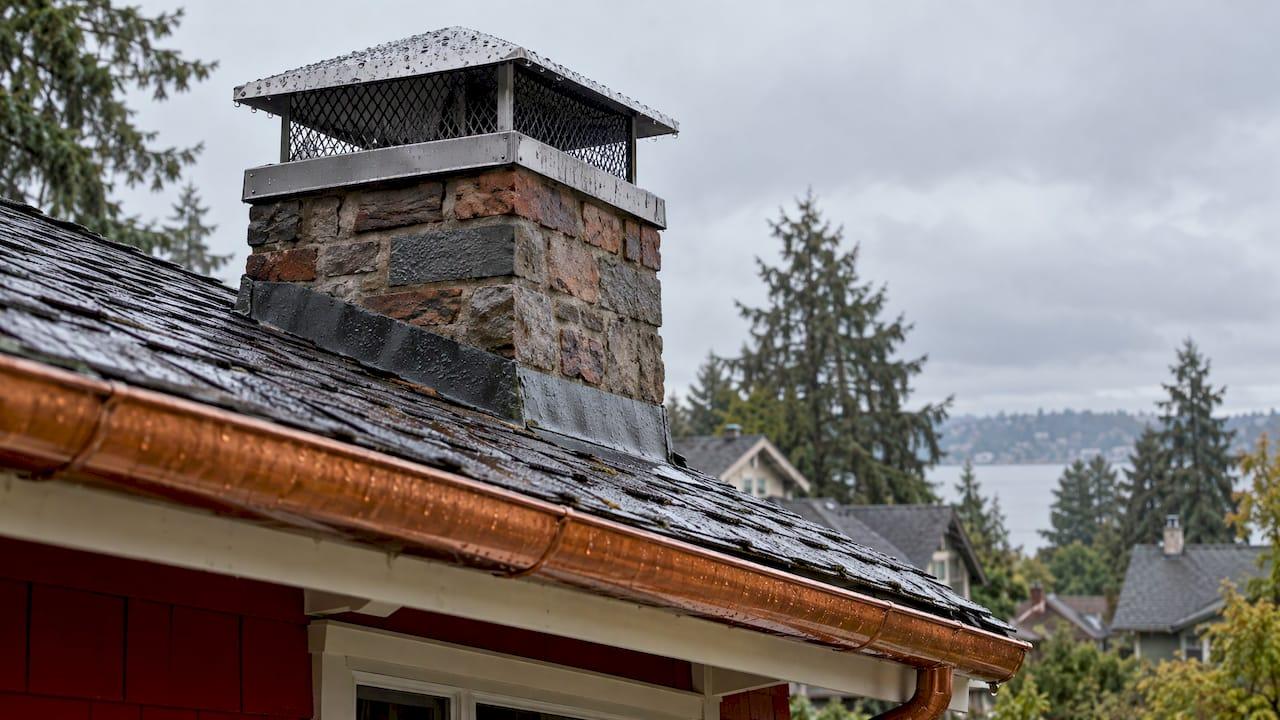
A chimney that smells after rain almost always has two things going on: creosote or soot on the flue walls, and water reaching them. Moisture makes old deposits smell stronger, and air moving down the flue carries that smell into the house. Sweeping out the deposits and sealing the water entry points ends the odor in most cases. In the Seattle area, where wet weather runs for months, it pays to have a professional chimney inspection before the smell becomes a pattern.
TL;DR
- Rain and humidity dampen creosote and soot, which makes the smell stronger. The smell is a sign of deposits, not just weather.
- Water entering through a missing cap, cracked crown, bad flashing or porous masonry keeps the deposits wet and can stain walls and ceilings.
- Downdraft, often made worse by air conditioning or exhaust fans, pulls the odor into the room even when no fire has burned for months.
- Cleaning heavy deposits and fixing the water entry point should end the odor. Moisture left alone can lead to mold.
- A gas fireplace that smells like rotten eggs is a different problem: leave the house and call for help first.
Table of Contents
- Why a chimney smells after rain
- Why it smells in summer too
- Can rain come down a chimney?
- Why it matters beyond the smell
- Will the smell go away on its own?
- Step by step: what to do when your chimney smells after rain
- Quick diagnosis table
- Gas fireplaces: a different smell, a different response
- Seattle-area homes: why wet weather matters
- Buying or managing a property
- Perspective
- Book the inspection before the next rain
- FAQ
- Sources
Why a chimney smells after rain
The smell has a simple chain of causes. Wood fires leave creosote and soot on the inside of the flue. Those deposits sit there all summer. Then rain falls, humidity climbs, and the deposits take on moisture.
The Chimney Safety Institute of America (CSIA) says chimney odors are usually worse in summer, when humidity is high and the air conditioner is running. It also says the real problem is air being drawn down the chimney. So the smell has two parts: a source (the deposits) and a delivery system (air moving into the house).
InspectApedia explains that water entering from the top of the chimney, or moisture condensing inside the flue, can dissolve creosote deposits. That produces a strong odor indoors. A downdraft then brings it into the living space. The same source says the odor usually points to heavy creosote deposits made worse by moisture or leaks.

What the smell tells you
Not every odor is the same. The nose gives clues:
- Campfire, tar or acrid smoke: creosote and soot, wetted by rain or humidity.
- Musty, damp or mildew: water is getting in and sitting somewhere, in the flue, the masonry or the surrounding structure.
- Sour or sharp, like ammonia: often described by homeowners with brick chimneys when it rains. It points to moisture working through deposits or masonry and deserves a look.
- Rotten eggs or sulfur near a gas fireplace: a gas safety issue, covered below.
A smell that returns every time it rains is not random. It is a repeating signal that water has a path into the system.
Why it smells in summer too
Many homeowners notice the smell in July, not January. The fireplace has not been lit in months. Why does it still stink?
Three things line up in warm weather:
- Humidity. Damp air is enough to wake up old creosote. You do not need a leak for the smell to show up.
- Temperature difference. In summer the air inside a cooled house can be cooler than the air in the flue. That can weaken or reverse the upward draft that normally carries air out.
- Negative pressure. Air conditioning, bath fans and kitchen range hoods push air out of the house. The house then pulls replacement air from wherever it can, and an open flue is a big opening.
CSIA's point holds here: the odor comes in because air is drawn down the chimney. A fan running in the kitchen can be enough. Close the damper when the fireplace is not in use, and the pull is reduced. A damper that does not seal well lets the smell through anyway.
The Seattle area has a mild summer, but marine air and long wet seasons keep humidity up for much of the year. A chimney that holds deposits will smell in more than one season.
Can rain come down a chimney?
Yes. Water gets in more ways than most homeowners expect. InspectApedia's guide to chimney leaks lists the common entry points:
- A missing or damaged chimney cap
- A cracked or crumbling crown, the slab at the top of a masonry chimney
- Leaks at the sides of the chimney or at the flashing where it meets the roof
- Porous masonry that soaks up water
- Surface runoff or roof spillage at the base
Each one feeds the same problem. Water reaches the flue or the masonry, soaks the deposits and carries the smell with it.
Where water leaves clues
Look for patterns, not just one stain. Write down:
- Where water shows up: in the firebox, on a ceiling near the chimney, on the chimney walls, in the attic.
- When it shows up: during rain, after rain, in windy weather, when the furnace or fans run.
- Whether recent roof or chimney work changed anything.
That record saves time on a service visit. It tells the technician whether the problem is at the top of the chimney, at the roofline or inside the masonry.
InspectApedia also notes something many homeowners miss. Water that dissolves creosote can make the thinned material seep out of the chimney in places other than the base or cleanout door, possibly elsewhere in the building. A leak stain indoors can be both a safety indicator and a source of odor. A brown stain near the chimney is not just cosmetic.

Why it matters beyond the smell
An odor is annoying. The cause behind it is the actual concern.
Creosote is fuel. Heavy buildup is a fire hazard. CSIA says masonry fireplaces should be swept when sooty buildup reaches 1/8 inch, or sooner if any glaze (hardened creosote) is present. Factory-built fireplaces should be swept when appreciable buildup occurs. If your chimney smells strongly, deposits are likely well past a light dusting.
Water damages masonry. Bricks, mortar and crowns break down when they stay wet. A small crack at the crown lets in more water each season. The smell may be the first sign you get before visible damage shows.
Damp materials grow mold. The US EPA says if there is mold growth in your home, you must clean it up and fix the water problem. Cleaning without fixing the water source means the mold will most likely come back. The EPA also says drying wet materials within 24 to 48 hours after a leak prevents mold growth in most cases. A chimney leak that soaks drywall or insulation nearby falls under that rule. For a deeper look at what happens when a leak reaches the structure, this guide on mold from a roof leak explains how to deal with the moisture and who to involve.
Will the smell go away on its own?
Usually, no. The smell may fade when the weather dries. It will return the next time humidity rises or rain hits.
InspectApedia says cleaning heavy creosote deposits and fixing leaks, a missing rain cap or other chimney defects ought to end the odor problem. That is the order that works:
- Remove the source (the deposits).
- Stop the water (the leak or missing cap).
- Reduce the pull (damper, doors, house pressure).
Skip step one and the smell stays. Skip step two and the deposits get wet again, so the smell comes back. Skip step three and a clean chimney can still pull outside smells down.
Smoke smell in the house
Homeowners also ask whether a smoke smell in the house will eventually go away. If it comes from old creosote and soot, it will not fully go away until the deposits are removed and the water source is fixed. Air fresheners cover it for a day. If the smell persists after a sweep, the next check is for a cracked liner, a damaged smoke chamber or a leak, which a Level 2 inspection with a camera can find.
Step by step: what to do when your chimney smells after rain
Step 1: Note the pattern
Write down when the smell appears, how strong it is and what the weather and house are doing. Rain only? Rain plus the AC? Windy days? This is useful, and it takes five minutes.
Step 2: Close the damper and fireplace doors
A closed damper reduces downdraft. A damper that is warped, rusted or does not seal will not help much. A top-sealing damper fits at the top of the flue and seals tighter than a throat damper. If your damper does not close fully, mention it at your inspection.
Step 3: Get the chimney inspected
CSIA, citing NFPA 211, says chimneys, fireplaces and vents should be inspected at least annually for soundness, deposits and correct clearances, even when little used. Animals and deterioration can make a system unsafe without obvious signs outside. A smell after rain is a good reason to book that inspection now rather than wait for fall.
Our chimney inspection service covers Levels 1 to 3, and inspections are photo-documented, so you see what we see. A Level 1 looks at the readily accessible parts. When the cause may be hidden, such as a damaged liner or a leak inside the structure, a deeper level is the right tool.
Step 4: Sweep the chimney and remove creosote
A chimney sweep removes loose soot and light buildup. Heavy or glazed creosote needs creosote removal, which is a more involved job. Cleaning products sold for home use are not a substitute. CSIA warns about chemical cleaners for a reason: reducing visible deposits is not the same as inspecting for hidden defects or removing loosened debris from smoke shelves, offsets and other places you cannot reach. A sweep with proper tools and a camera check handles both.
For more on timing and what a visit involves, see our guide to wood stove chimney cleaning and the breakdown in chimney cleaning cost.
Step 5: Fix where water gets in
This is the step that keeps the smell from coming back. Depending on what the inspection finds, the repair can include:
- A new chimney cap to keep out rain and animals
- Crown repair
- Flashing repair at the roofline
- Masonry repair, including repointing and brick replacement
- Waterproofing of porous masonry
- Relining if the flue itself is damaged
All of these fall under chimney repair. Cracks in the stack are covered in cracked chimney repair, and a stack that has shifted is covered in leaning chimney repair.
Step 6: Dry out anything that got wet
If water reached the ceiling, attic or walls, dry those materials quickly. The EPA's 24 to 48 hour window is the target. Ongoing dampness near the chimney needs attention from whoever handles the affected material, plus a fix at the source.
Quick diagnosis table
| What you notice | Likely cause | What to do |
|---|---|---|
| Campfire or tar smell when it rains or is humid | Creosote and soot wetted by moisture | Inspection, sweep, creosote removal if glazed |
| Musty smell plus damp spots near the chimney | Water entry at cap, crown, flashing or masonry | Inspection, then repair of the entry point |
| Smell mostly when AC or fans run | Downdraft from negative pressure | Close damper, check damper seal, sweep deposits |
| Brown stains on ceiling or wall near chimney | Water carrying dissolved creosote | Inspection soon, dry the area, repair the leak |
| Smell after a sweep | Hidden defect, leak or damaged liner | Deeper inspection level, camera check |
| Rotten eggs near a gas fireplace | Possible gas leak | Leave the house, call for help |
Gas fireplaces: a different smell, a different response
If the smell is rotten eggs or sulfur and you have a gas fireplace, do not treat it as a rain odor. Natural gas has an added odorant so leaks can be noticed. Do not switch lights, appliances or phones on and off inside. Leave the house, then call your gas utility's emergency line or 911 from outside. Do not go back in until you are told it is safe.
Once the immediate danger is handled, a technician needs to diagnose and repair the unit. Our page on what to do when a gas fireplace smells like gas covers the next steps, and gas fireplace insert repair explains common faults. We handle gas fireplace diagnostics and repairs across the Seattle area.
A gas fireplace can also have a damp, musty smell after rain if the vent or chimney it connects to is taking in water. That is a moisture issue, not a gas issue, and an inspection sorts out which one you have.
Seattle-area homes: why wet weather matters
The Puget Sound region has a long rainy season. Chimneys in Seattle, Tacoma, Gig Harbor and across King County spend months wet. Masonry that is cracked or poorly sealed absorbs water, and water that reaches the flue keeps creosote damp.
That is why a chimney that seemed fine in a dry year can start to smell after a wet one. A hairline crack at the crown or a loose cap lets in a little water at a time. Over a season it adds up.
We recommend checking the chimney before the wet season, and again if a smell shows up. Pre-season service also means you are not waiting for a busy fall schedule. If you are looking at local repair work, our write-up on chimney repair in Tacoma walks through signs and fixes, and our Bellevue service area page shows where we work on the Eastside.
Buying or managing a property
A smell after rain is a common find during a home purchase or on a rental. First-time buyers often hear it described as just an old fireplace smell. It is worth a proper inspection. A chimney with damp deposits, a missing cap or a failing liner is easier and cheaper to deal with before closing or before tenants complain.
Property managers benefit from the photo record. Before-and-after images document what was found and what was done, which helps with owner reports and repeat visits.
Perspective
We hear the same story from homeowners across the Seattle area. The fireplace has not been lit in months, but every rainy day the room smells like an old campfire.
Our view is simple. That smell is a symptom. Cleaning it up with a spray or a candle is not the fix. The fix is to find where the water is getting in and remove what the water is waking up.
That is why we start with a thorough inspection and document it with photos. You see the cap, the crown, the flue walls and the masonry the way we see them. Then we price the work upfront, so you know what you are choosing.
A sweep takes care of deposits. Repairs take care of water. Doing both in the right order is what keeps the smell from coming back next rain. We are licensed and insured, local and available 24/7 when something cannot wait.
Damon
Book the inspection before the next rain
If your chimney smells after rain, the quickest way to find out why is to have it inspected. Prime Chimney provides sweeps, Level 1 to 3 inspections, creosote removal, masonry repair, waterproofing, relining, cap and crown work and gas fireplace repairs for homeowners and property managers in the Seattle metro area. Our inspections come with photos, our pricing is upfront and our work carries a 5-star rating across multiple platforms.

Start with a chimney inspection, or visit Prime Chimney to see the full list of services.
FAQ
Will mildew smell eventually go away?
Not while the moisture source is still there. The EPA says that if you clean up mold but do not fix the water problem, the mold will most likely return. Find the leak, dry the materials and remove the deposits, and the odor should clear.
Why does my house smell bad after it rains?
If the smell is smoky or tar-like and strongest near the fireplace, damp creosote and downdraft are the usual cause. Moisture wakes up old deposits, and air drawn down the flue brings the odor inside. A sweep and a check for water entry deal with it.
Can rain come down a chimney?
Yes. Water can enter through a missing cap, a damaged crown, flashing leaks, porous masonry or runoff at the base. Dripping in the firebox, ceiling stains and damp masonry are common signs. An inspection finds which path the water is taking.
Why does my chimney smell in summer when I have not used it?
Humidity and air conditioning are the usual reasons. Damp air strengthens old creosote, and a cooled house with running fans pulls air down the flue. Closing the damper and having the chimney swept reduces the smell.
What if my gas fireplace smells like rotten eggs?
Leave the house right away and call your gas utility's emergency line or 911 from outside. Do not use switches or flames inside. Have the fireplace diagnosed and repaired before using it again.
Sources
- Chimney Safety Institute of America: Homeowner Resources
- InspectApedia: Chimney Creosote Odors and Smells
- InspectApedia: Chimney Leaks and Water Damage
- US EPA: A Brief Guide to Mold, Moisture and Your Home